

Quick Verdict
This one comes down to what you are actually buying.
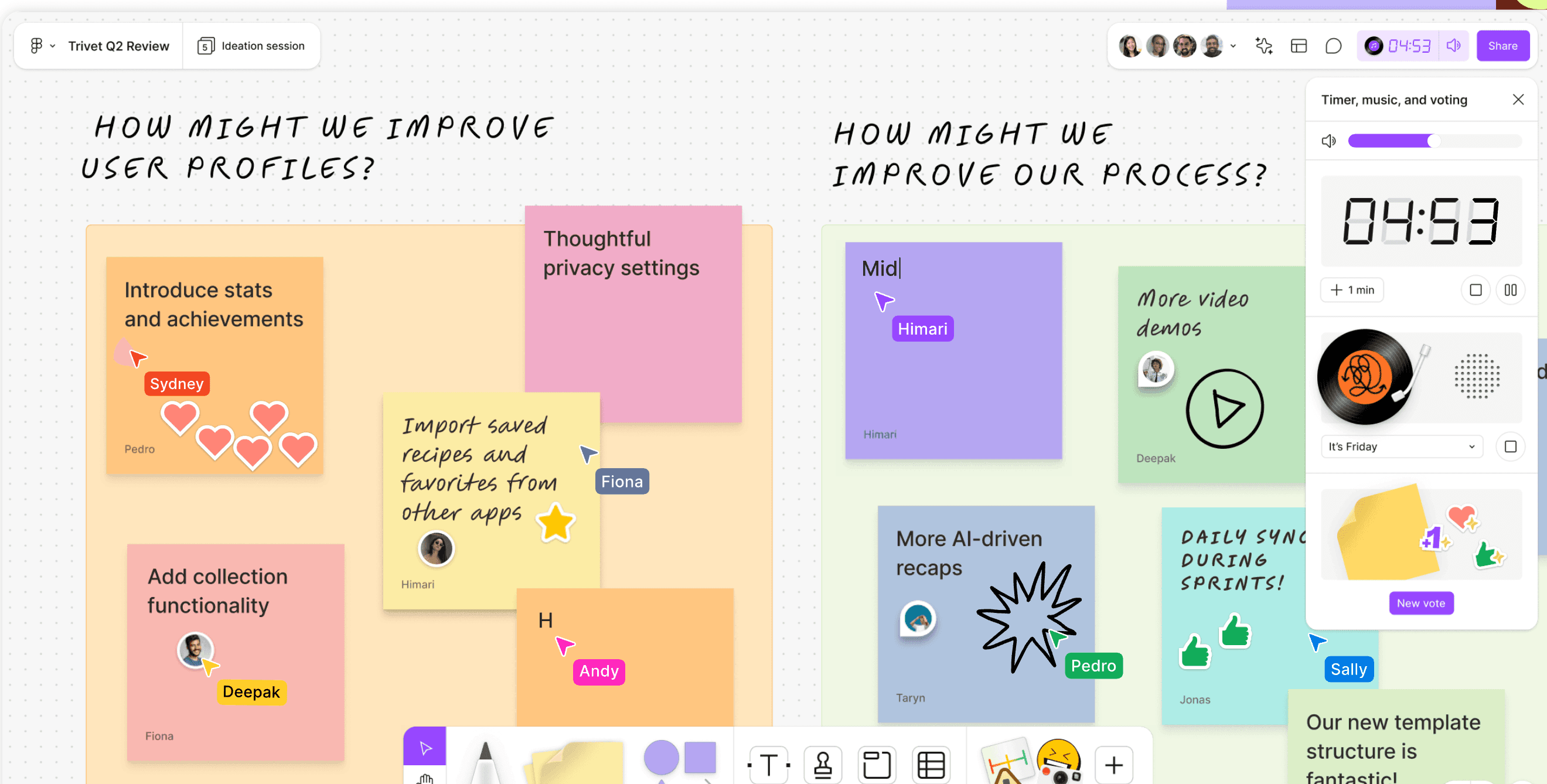
FigJam is a general-purpose whiteboard that happens to be good at retros. Native voting sessions, a timer, a music player, and AI sticky sorting cover the mechanics of the meeting, and since Figma's 2025 pricing change it is bundled into every Figma seat. If your org already pays for Figma, running retros in FigJam costs you nothing new.
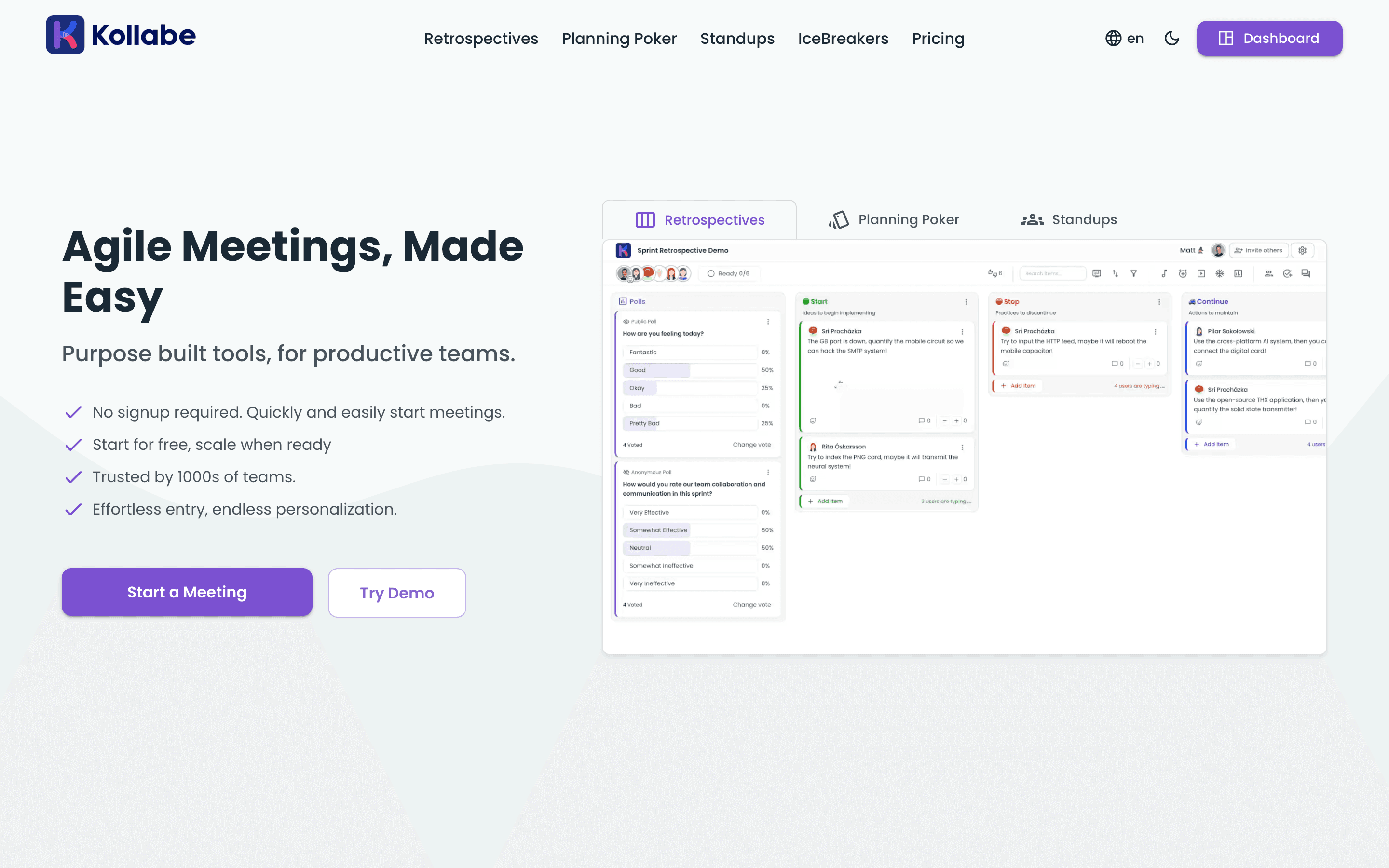
Kollabe is a purpose-built agile ceremonies platform. Retros come with real anonymity, action items that carry over between sprints, and AI that groups, summarizes, and tracks sentiment. Then it adds planning poker and async standups for the same flat $29/month. If retros are a workflow you run every two weeks and follow up on, Kollabe does the whole job. FigJam does the meeting and leaves the follow-through to you.
Feature Comparison
Both tools handle a live retro competently. Voting with hidden results, timers, templates, stickies, reactions. The gap opens before the meeting starts and after it ends.
Before the meeting: Kollabe is anonymous by default when you want it to be, per session, with mixed anonymous and attributed input. FigJam's anonymity is cosmetic. You can hide sticky author names, but the attribution is stored and the same toggle reveals it again. For teams where honest feedback needs actual cover, that difference is the whole decision.
After the meeting: Kollabe tracks action items with owners and due dates, carries unresolved ones into the next retro, and exports them to Jira, GitHub Projects, or Linear in one click. FigJam has no action item concept at all. Whatever your team commits to becomes a sticky that nobody looks at again, unless someone manually creates tickets through the Jira widget.
FigJam's counterpunch is the canvas itself. It is an infinite whiteboard with drawing tools, stamps, emotes, washi tape, and a music player, and nothing in Kollabe matches that looseness. Journey maps, diagrams, workshop exercises that spill outside a column format: FigJam absorbs them all. Kollabe's drawing canvas and 30 themes add personality, but it is still a structured retro board at heart.
Kollabe covers three ceremonies — retros, planning poker with ticket import and estimate write-back, and async standups — in one subscription. FigJam covers one ceremony natively and approximates the rest through third-party Community widgets of varying quality.
Pricing Comparison
The pricing models are different shapes: FigJam is per seat, Kollabe is per team.

FigJam
Collab seat, annual billing — bundled into all Figma plans
- Included with existing Figma seats
- Free tier: 3 files, unlimited collaborators
- 150 free AI credits/day
- SSO on Organization plan ($5/seat)

Kollabe
Flat per team — retros, poker, and standups included
- Unlimited participants and history
- All AI features included
- Planning poker and async standups included
- Free tier available (10 participants)
For a ten-person team with no Figma contract, the math lands close: ten Collab seats at $3 is $30/month against Kollabe's flat $29. Below ten people FigJam is cheaper; above it, Kollabe pulls ahead, and its price never moves as the team grows.
The real pricing story is elsewhere. If your company already pays for Figma, FigJam is effectively free, and no procurement conversation beats that. On the other side, Kollabe's $29 includes poker and standups, so if you would otherwise buy a separate estimation tool, the flat fee replaces two or three line items. FigJam's free tier is only good for a taste: 3 files total, which a biweekly retro cadence exhausts in six weeks.
Ease of Use
FigJam wins the first five minutes. Anyone who has touched Figma knows the canvas already, and everyone else finds it friendlier than any whiteboard this side of a paper flipchart. Participants join by link. The stamps and emotes do real work in remote retros, giving quiet people a low-effort way to react.
Facilitating is another matter. FigJam has no phases, no guided flow, and no facilitator-only controls, so the scrum master builds the agenda from sections and drives everything by hand. Kollabe gives you customizable workflow phases, per-phase timers, and voting controls that belong to the facilitator. New scrum masters get guardrails; experienced ones get less to babysit.
Both are browser-based with no install required for participants. FigJam has desktop and mobile apps via Figma; Kollabe is responsive web only.
Integrations
Different priorities, roughly even coverage, almost no overlap.
Kollabe integrates deep with issue trackers: Jira, GitHub, Azure DevOps, and Linear, all two-way. JQL and WIQL ticket import into poker, estimates written back to story points, action items exported as issues. Confluence export rounds it out. That is plumbing FigJam mostly lacks: its Jira and GitHub widgets put issues on the board and create new ones, but there is no Azure DevOps, no Linear, and no estimation write-back.
FigJam's ecosystem strengths run the other way. Official Slack and Microsoft Teams apps handle notifications and embedding, Asana has a real widget, and the Confluence app embeds live boards. Kollabe has no Slack or Teams integration at all, which stings for teams that live in chat.
Both now expose a public API. Figma's is mature and well-documented; Kollabe's launched in February 2026.
AI and Automation
FigJam AI does two useful things in a retro: sorts selected stickies into themed groups and summarizes them into a takeaway note. Both work well and both consume AI credits, which the free plan caps at 150/day. The 2025 addition of prompt-to-board generation is fun but less load-bearing.
Kollabe's AI goes further because the product knows what a retro is. Grouping runs on semantic similarity, summaries accept custom instructions, sentiment and engagement trends accumulate across sessions, and the AI template generator builds formats from a theme. Standups get AI digests daily or weekly.
Neither tool automates the meeting away. But Kollabe's AI is woven through a workflow, while FigJam's is a pair of canvas tools you invoke by hand.
Who Should Choose Which?
Choose FigJam if…
- Your company already pays for Figma, making FigJam effectively free
- You want retros, workshops, and diagrams on one infinite canvas
- Stamps, emotes, and music matter for your team's energy
- You need SOC 2, ISO 27001, and SSO to clear security review
- You want desktop and mobile apps
Choose Kollabe if…
- You need action items with owners that survive between sprints
- True anonymous feedback matters to your team
- You run planning poker and standups, not just retros
- You want ticket import and estimate sync with Jira, GitHub, Azure DevOps, or Linear
- Flat $29/month regardless of team size
Final Recommendation
For most teams shopping specifically for a retrospective tool, Kollabe is the stronger buy. The things that make retros compound — real anonymity, action items with owners and carryover, trend-aware AI — are exactly the things FigJam does not have, and the poker and standup coverage make the $29 stretch further than a whiteboard subscription.
The reversal is just as clear. If Figma is already on your invoices, FigJam delivers a genuinely enjoyable retro for zero incremental dollars, with the compliance checkboxes (SOC 2, SSO, audit logs) that Kollabe cannot tick. Plenty of design-heavy orgs will reasonably stop there.
Buy Kollabe if retrospectives are a process you want to get better at. Use FigJam if they are a meeting you want to run well on a canvas you already own. For the wider field, our guide to the best retrospective tools covers where both sit.