

Quick Verdict
GoRetro and Kollabe both price per team instead of per user, and both bundle planning poker with retrospectives. That's roughly where the overlap stops.
Kollabe ships AI grouping, AI summaries, async retros, a full standup tool, and integrations with GitHub, Linear, and Azure DevOps. GoRetro leans into sprint management: a happiness index, capacity calculator, and Jira-centric sprint monitoring. But its feature set hasn't visibly expanded since mid-2023, which is worth knowing.
If your team wants one platform for retros, poker, and standups with active development behind it, Kollabe is the better pick. If you live in Jira and specifically want sprint monitoring with capacity planning baked in, GoRetro's Sprint Pro plan does something most retro tools don't.
Feature Comparison
Both tools cover the retro basics: anonymous cards, dot voting, timers, action items. The split is AI and ceremony breadth.
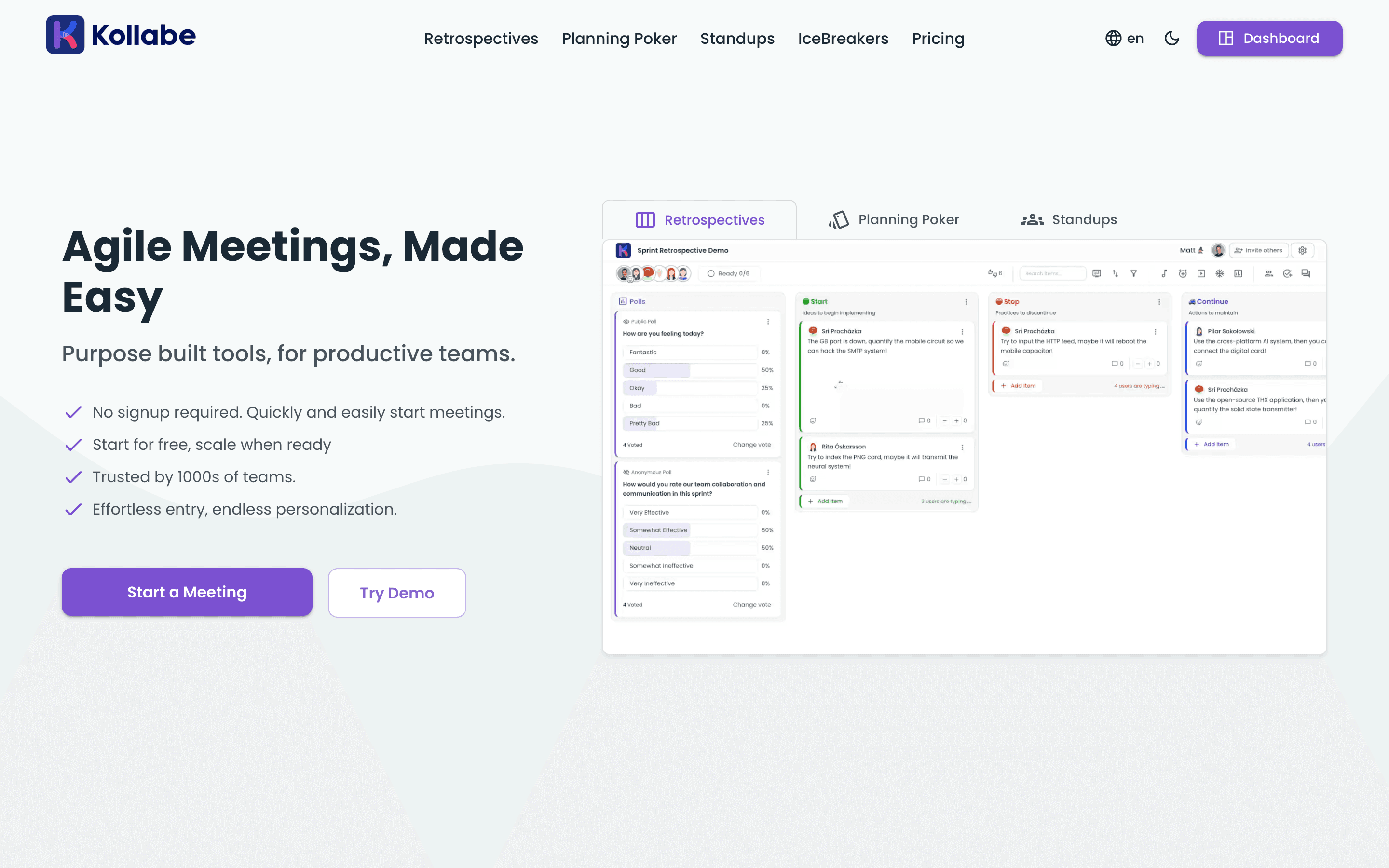
Kollabe's AI groups related cards using semantic similarity, not keyword matching. After 20+ people dump 80 cards onto a board, that saves 10-15 minutes of manual dragging. It also generates post-session summaries with suggested action items, and you can customize the AI's behavior with custom instructions. GoRetro doesn't have AI grouping at all. Its "meeting recap" feature is a basic export, not AI-generated analysis.
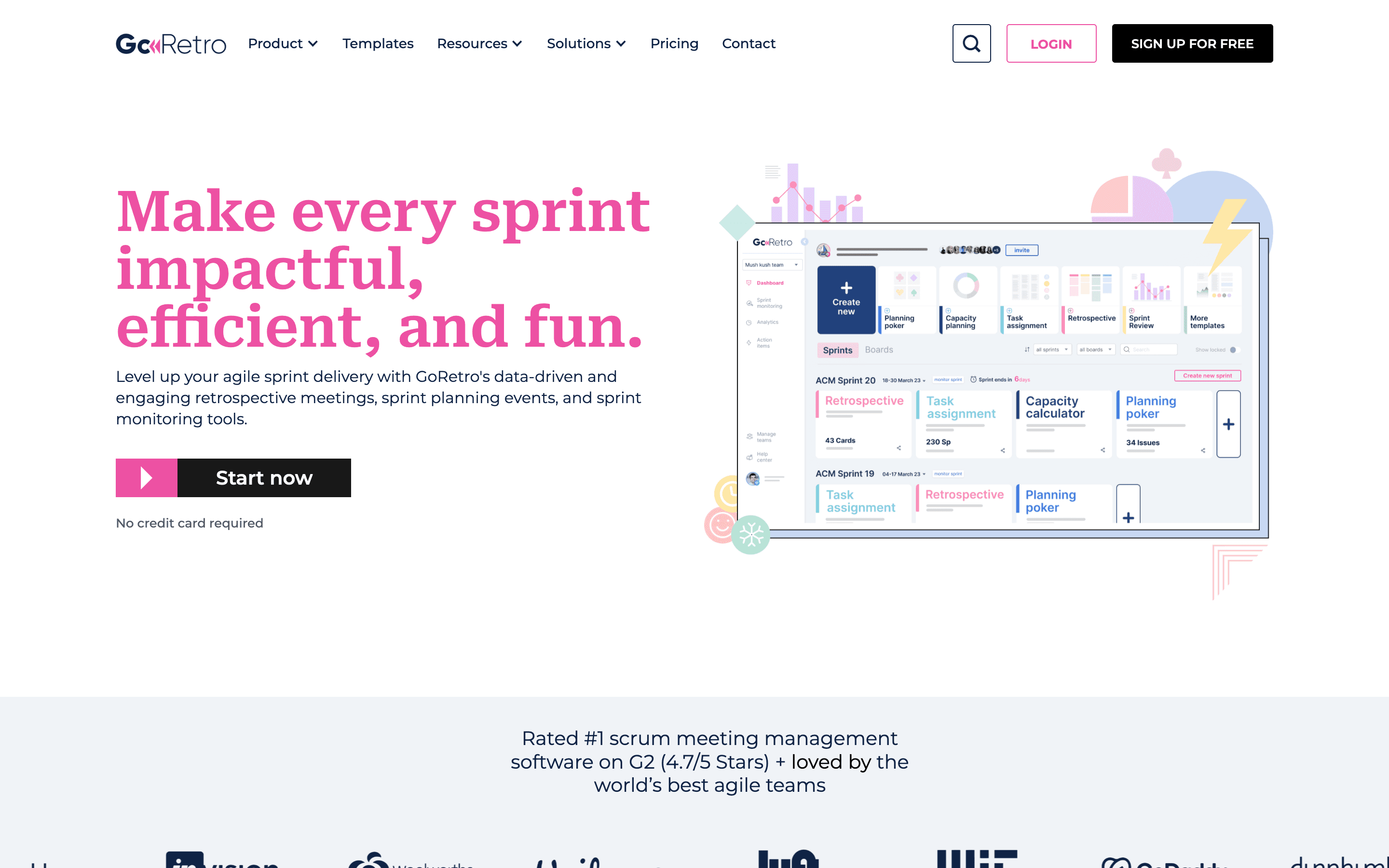
GoRetro has something Kollabe doesn't: sprint monitoring. Connect your Jira board and GoRetro pulls in real-time sprint data, including mid-sprint bug counts, task-type breakdowns, and cycle time metrics. The Sprint Pro plan adds a capacity calculator that tracks team velocity. If your scrum master wants retro discussions grounded in actual sprint numbers, that matters.
GoRetro's public changelog hasn't been updated since May 2023. Kollabe shipped 10+ features in January and February 2026 alone, including a public API, inline polls, and a Linear integration. If you're picking a tool for the long haul, development pace matters.
On templates, Kollabe has over 1,000 themed templates plus an AI generator. GoRetro has 34. Both support custom templates, but the starting library isn't close.
Pricing Comparison
Same base model, similar price. What you get for it is not.

GoRetro
Premium plan, billed annually
- Retros with unlimited boards
- Slack action item export
- Analytics and happiness tracking
- Planning poker requires $49/mo Sprint Pro

Kollabe
Premium plan, monthly or annual
- Retros, poker, standups, icebreakers
- AI grouping and summaries included
- Jira, GitHub, Linear, Azure DevOps
- Free tier: 10 participants, 7-day history
Here's the catch: GoRetro's $29/month Premium plan doesn't include planning poker. You need Sprint Pro at $49/month for that. Kollabe's $29/month Premium includes everything: retros, poker, standups, icebreakers, all AI features, all integrations.
So a team that needs both retros and poker pays $49/month on GoRetro versus $29/month on Kollabe. That's 69% more for fewer features. GoRetro also requires annual billing at those prices. Kollabe offers monthly.
Both tools price per team, so neither punishes you for adding members. But GoRetro's free plan caps you at 1 team and 5 public boards, while Kollabe's free plan allows up to 10 participants per room with 7-day history.
Ease of Use
GoRetro keeps things simple. Add cards, vote, discuss, done. No account required for participants. Facilitator controls are what you'd expect: hide cards, limit votes, set timers.
Kollabe covers more ground, which means more to learn up front. The core retro flow is just as quick though. And the AI actually cuts facilitation work, since the grouping and summary steps that usually fall on the facilitator happen automatically. Most teams figure out the interface within one session.
Neither tool has native mobile apps. GoRetro's mobile web experience is unclear since there's no evidence of responsive design. Kollabe works in mobile browsers.
Integrations
Big gap here.
Kollabe connects to Jira, GitHub, Azure DevOps, Linear, and Confluence. You can import tickets into planning poker from any of those, sync estimates back automatically, and export action items as issues. The Confluence export turns retro results into wiki pages with one click.
GoRetro integrates with Jira and that's about it. There's a Slack integration for pushing action items to a channel, which Kollabe lacks entirely. But if your team uses GitHub, Linear, or Azure DevOps for work tracking, GoRetro can't touch any of them.
Neither tool has a Microsoft Teams integration. Kollabe also lacks Slack. If your team relies on chat notifications for retro reminders or action item follow-ups, both tools leave a gap, though GoRetro's Slack export is better than nothing.
AI and Automation
Not much of a contest here.
Kollabe's AI grouping clusters related feedback cards by meaning, not keyword matching. Summaries pull out themes and suggest action items. Sentiment analysis tracks mood shifts over time. You can also customize the AI's instructions for your team's context, like telling it to focus on deployment issues or summarize in a certain format.
GoRetro's version of "intelligence" is the happiness index: a 1-5 mood rating each participant submits per retro, tracked across sprints. That's useful longitudinal data. But it's a manual input, not AI. The "Joker Cards" feature generates discussion prompts from sprint data, which is creative. It's pattern matching on Jira metrics though, not analysis of what your team actually wrote.
For teams generating lots of feedback cards, the AI grouping alone tips the scales toward Kollabe. A small team of 5 generating maybe 15 cards per retro won't feel the grouping gap as much, but the summaries and sentiment trends still add value.
Who Should Choose Which?
Choose GoRetro if…
- Your team lives in Jira and wants sprint monitoring with real-time data
- You need a capacity calculator and velocity tracking alongside retros
- Slack integration for action item notifications matters to your workflow
- You want a happiness index tracking team mood over time
- GDPR compliance is a hard requirement
Choose Kollabe if…
- You run retros, poker, and standups — one subscription covers all three
- AI grouping and summaries save real facilitation time with larger teams
- Your team uses GitHub, Linear, or Azure DevOps alongside or instead of Jira
- You want active development with frequent feature releases
- You need 1,000+ templates and an AI template generator to keep retros fresh
Final Recommendation
For most agile teams, Kollabe is the better buy. At $29/month you get retros, planning poker, standups, icebreakers, AI grouping, AI summaries, and four dev platform integrations. GoRetro charges $49/month just to unlock poker, has no AI grouping, and only connects to Jira.
GoRetro fills a specific niche though. Teams deep in Jira who want sprint monitoring and capacity planning alongside their retros will find features here that most retro tools skip entirely. The happiness index and Joker Cards are useful for tracking team health across sprints. If that describes your setup, GoRetro is worth a look.
But on features per dollar, Kollabe comes out ahead. And with 10+ features shipped in early 2026 versus GoRetro's quiet changelog since 2023, the development gap is only getting wider.