

Quick Verdict
These two tools barely belong in the same category, and that's the whole point of the comparison.
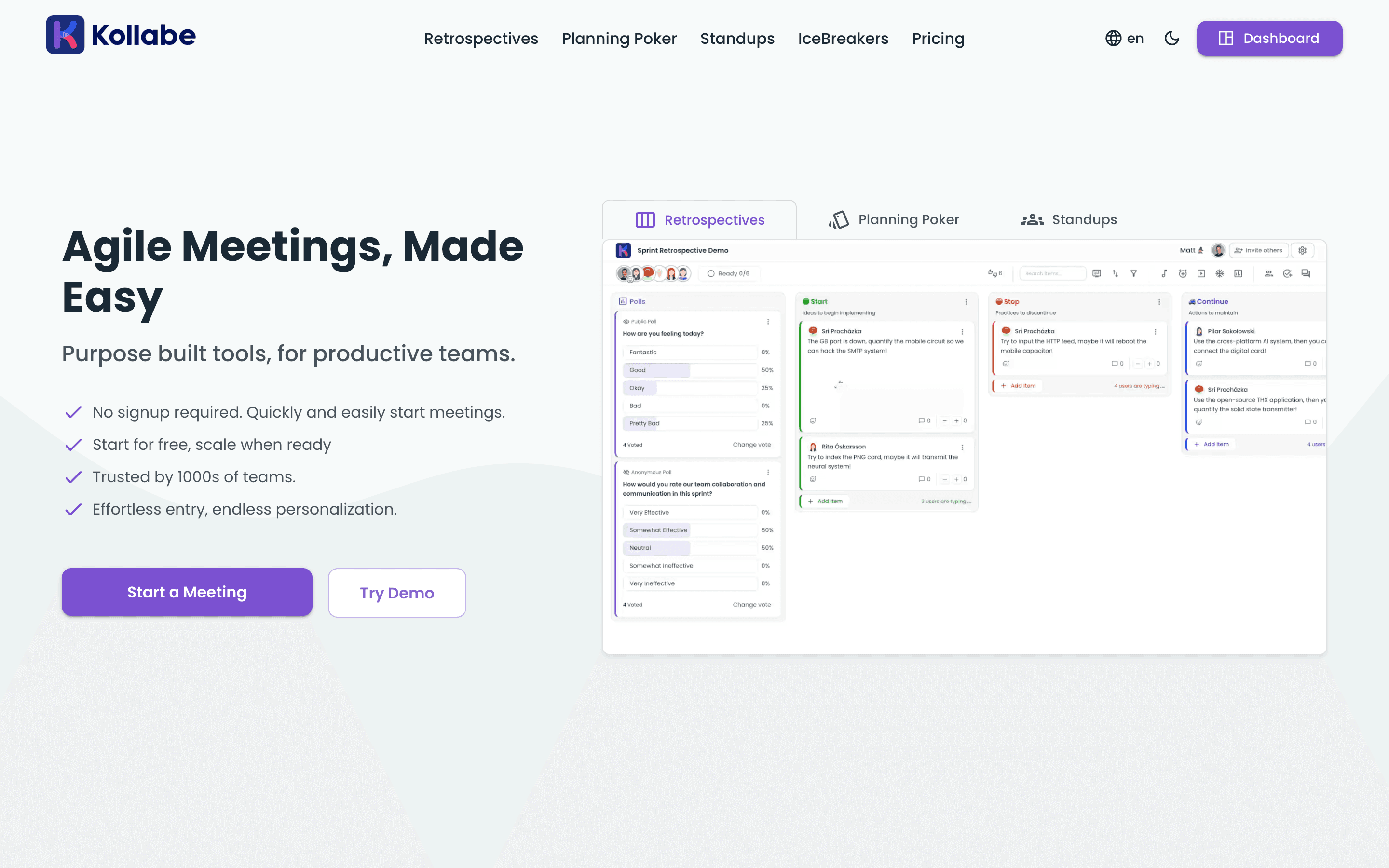
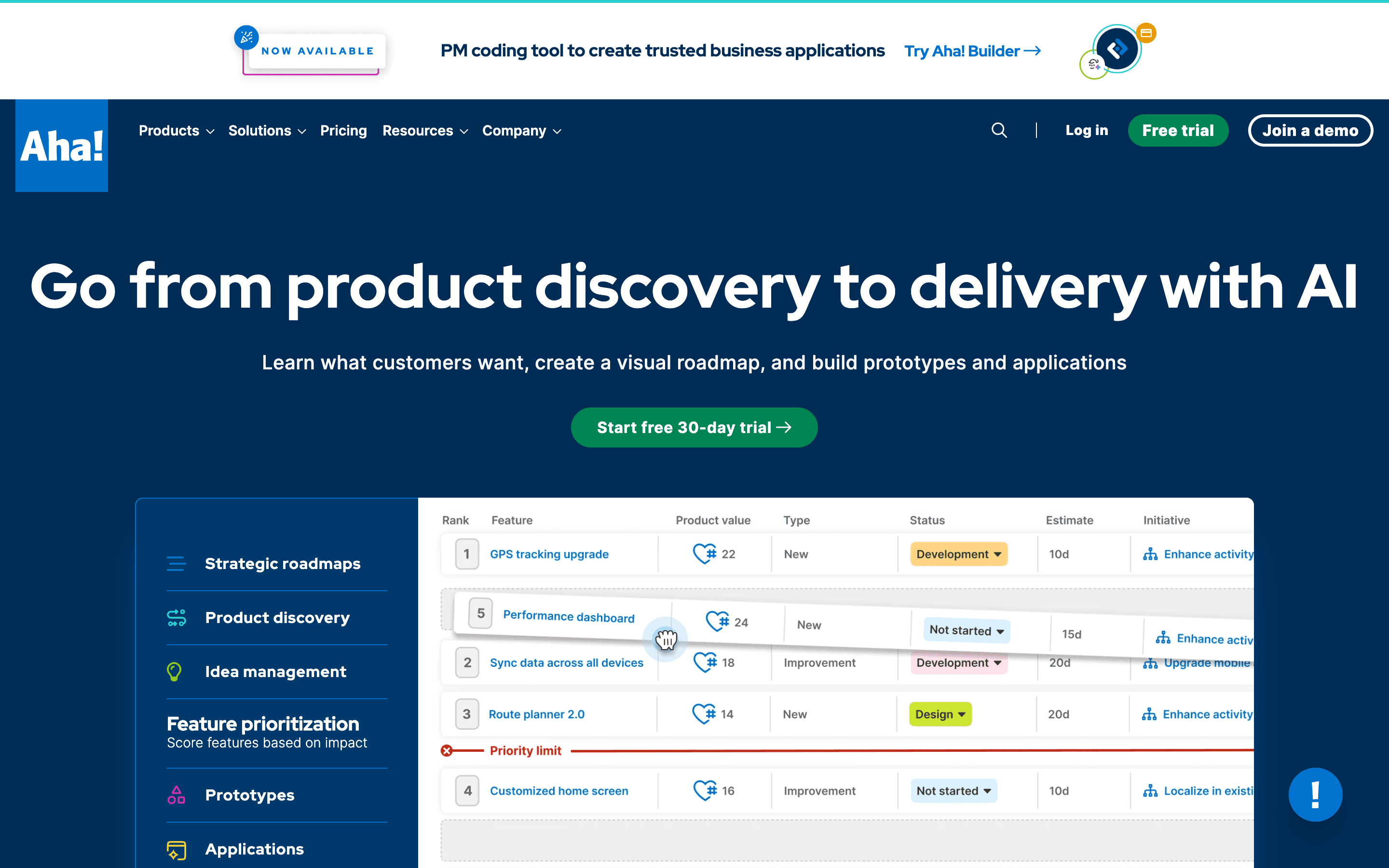
Kollabe is a dedicated agile ceremonies tool. Retros, planning poker, standups, and icebreakers are the entire product. Aha! is a product management and roadmapping suite used by a million product builders, and retrospectives are a minor feature buried inside Aha! Develop and Aha! Whiteboards. You don't buy Aha! to run retros. You buy it to plan roadmaps and manage strategy, and the retro boards come along for the ride.
So the answer depends on a single question: do you need product roadmapping, or do you need to run ceremonies? If your team already pays for Aha! to manage the product, running a sprint retro on an Aha! Whiteboard keeps everything in one place. That's a real convenience. But if you just want to facilitate retros without buying a whole PM suite, Kollabe does it better and costs a fraction as much.
For the retro and ceremony use case specifically, Kollabe wins on AI, templates, async support, and value. Aha! wins on being a far broader product tool, which most teams looking at a retro comparison don't need.
Feature Comparison
The gap shows up the moment you look past the basics. Both tools do anonymous voting, timers, comments, and a handful of retro templates. After that they split hard.
Kollabe was designed around facilitation. AI grouping clusters similar cards by meaning, not keywords. AI summaries are customizable, so you can tell the AI to focus on deployment pain or team morale and it will. Sentiment analysis tracks mood across sessions. There are roughly 1,000 templates plus an AI generator that builds a custom one from a theme you type in. Guided facilitation walks the team through phases, and the whole thing runs async if half your team is in another timezone.
Aha! has none of that on the retro side. No AI grouping. No AI retro summaries. No sentiment analysis for retro boards. No guided facilitation that advances a session through collect, group, vote, discuss. Its AI assistant is built for drafting roadmap content and research, not summarizing what came out of your retro. Aha! ships around 100 whiteboard templates total, of which maybe a dozen are retro formats — sailboat, starfish, start/stop/continue, the SAFe PI retro.
The single biggest difference: Aha! has no guided facilitation and no AI built for retros. You get a whiteboard with sticky notes and a voting timer. Kollabe walks a facilitator through phases and does the grouping, summarizing, and sentiment read for you. For a scrum master running the session live, that's the difference between facilitating and babysitting a canvas.
Where Aha! pulls ahead is everything that isn't a retro. Full sprint planning with capacity and backlog. SAFe PI planning with confidence voting. Velocity, burndown, throughput, and cycle-time reports in the Develop Advanced sprint retro report. Roadmaps, scoring, dependencies. If you need that data, no retro tool comes close. Kollabe doesn't do capacity planning, velocity tracking, or burndown charts at all. It's not trying to.
Both have planning poker. Kollabe imports tickets from Jira (JQL), GitHub, Azure DevOps, and Linear, then syncs the winning estimate back to story points automatically. Aha!'s poker lives in Whiteboards Advanced and ties votes to Aha! records, but there's no direct Jira estimate sync. On standups, it's not a contest: Kollabe has async daily standups with AI summaries; Aha! has a template and a help article, no standup tool.
Pricing Comparison
This is where the two-products-in-one-comparison really shows. One charges flat per team; the other charges per user across a stack of add-ons.

Kollabe
Flat per team — retros, poker, and standups included
- Unlimited participants and history
- All AI features included
- Free tier available (10 participants)
- Per Space — 3 teams = 3x

Aha!
Develop Advanced ($18) + Whiteboards Advanced ($9) for a full retro setup
- Per user, billed annually
- No free plan — 30-day trial only
- Develop Advanced adds sprint retro reports
- Whiteboards Advanced adds poker + custom templates
Kollabe is $29/month flat, per team, for everything: retros, poker, standups, all the AI, unlimited people. A 10-person squad pays $29. A 30-person team still pays $29.
Aha! charges per user, and to get a retro experience worth running you need Develop Advanced at $18/user/month for the sprint retro report plus Whiteboards Advanced at $9/user/month for collaborative boards and poker. That's $27/user/month. For a 10-person team, that's $270/month against Kollabe's $29. There's no free plan either, just a 30-day trial.
Kollabe's pricing weakness is real, so name it: it's per Space, so three separate teams cost 3x ($87/month). But you'd have to run nine teams on Kollabe before you matched what a single 10-person Aha! retro setup costs. The math only flips toward Aha! if you're already paying for the suite for roadmapping, in which case retros are effectively a free add-on you've already bought.
Ease of Use
Aha! is a deep platform, and depth costs you setup time. There's a real learning curve: custom workspaces, record types, integration mapping, and a feature set built for product managers, not facilitators. Reviewers consistently flag the onboarding as steep. Getting from signup to a running retro means understanding where Whiteboards sits relative to Develop relative to Roadmaps.
Kollabe is narrow on purpose, and that makes it fast. Create a Space, pick a template, share a link, run the retro. New scrum masters can facilitate a guided session on day one without learning a product taxonomy first. The AI grouping removes the manual clustering step that eats five minutes mid-session.
Both run in the browser with nothing to install, and neither has native mobile or desktop apps. Aha! does have iOS and Android apps for its Roadmaps product, but retro and whiteboard functionality on mobile is limited.
Integrations
Aha! wins this category outright, and it's not close. It connects to 65+ tools: Jira, GitHub, Azure DevOps, GitLab, Confluence, Salesforce, Zendesk, ServiceNow, Trello, Asana, Figma, plus Zapier. That breadth makes sense. A product management suite has to plug into sales, support, design, and engineering, not just the dev board.
Kollabe connects to fewer tools but goes deep where it counts for ceremonies: Jira, GitHub, Azure DevOps, Linear, and Confluence. The Jira integration does JQL ticket import for poker, two-way estimate sync, and action item export. Aha! has broader reach; Kollabe has tighter integration with the dev tools a retro actually touches.
Neither tool integrates with Slack the way a retro team usually wants. Kollabe has no Slack or Microsoft Teams integration at all. Aha! can broadcast roadmap activity one-way into Slack and Teams channels, but it won't post your retro summary there. If posting outcomes to Slack matters, both will disappoint you.
One more honest gap on Kollabe's side: no Zapier, no webhooks (a public API launched in February 2026, which may close some of that). Aha! has had Zapier and a mature API for years. For automation-heavy orgs, Aha! is the more connected platform.
AI and Automation
This is Kollabe's strongest category and Aha!'s weakest on the retro front.
Kollabe's AI is built for ceremonies. It groups retro cards by semantic similarity, writes summaries you can steer with custom instructions, tracks sentiment trends, and generates standup summaries on a daily, weekly, or fortnightly cadence. There's also an AI template generator. Across retros, poker, and standups, the AI is doing facilitation work that would otherwise fall on the scrum master.
Aha! has a capable AI assistant, but it's pointed at product work — drafting requirements, summarizing research, helping write roadmap content. For retros specifically, it does no grouping, no retro summaries, and no sentiment read. Aha! Discovery has sentiment AI for customer interviews, but that doesn't touch your retro board.
If AI-assisted facilitation is why you're shopping, Kollabe is the clear answer. If you want AI to help draft a product roadmap or analyze user interviews, Aha! has tools Kollabe will never build.
Who Should Choose Which?
Choose Kollabe if…
- You want to run great retros, poker, and standups without buying a whole PM suite
- You want AI grouping, AI summaries, and sentiment built specifically for retros
- You need fully async retros and standups for a distributed team
- Flat $29/month per team beats $27/user/month for a small squad
- New facilitators want guided phases and fast setup, not a learning curve
Choose Aha! if…
- Your org already uses Aha! for roadmaps and wants retros in the same place
- You need product roadmapping, scoring, and strategy, not just ceremonies
- You want sprint reports with velocity, burndown, and cycle-time data
- You run SAFe PI planning with confidence voting
- You need 65+ integrations across sales, support, design, and engineering
Final Recommendation
For running retrospectives and agile ceremonies, Kollabe is the better tool, and the price difference isn't subtle. A 10-person team pays $29/month for Kollabe against roughly $270/month to assemble a comparable retro setup in Aha!. On the axes that matter for facilitation — AI grouping, steerable summaries, sentiment, 1,000-plus templates, guided phases, and real async support — Kollabe is built for the job and Aha! isn't.
But this comparison has an honest asterisk. Aha! and Kollabe aren't really competing for the same buyer. Aha! is a product management suite where retros are a side feature; Kollabe is a ceremonies tool that doesn't do roadmaps, capacity planning, or strategy at all. If your org already runs on Aha! for product work, holding a retro on an Aha! Whiteboard is a sensible add-on you've effectively already paid for.
So pick Aha! if you need end-to-end product management and want retros in the same workspace. Pick Kollabe if you want to facilitate excellent retros, poker, and standups on their own. For distributed teams in particular, Kollabe's async retros and standups solve a problem Aha! never set out to solve. Most teams shopping for a retro tool should look at Aha! only if they were going to buy the suite anyway.