

Quick Verdict
These two tools aren't really in the same category, and that's the whole story.
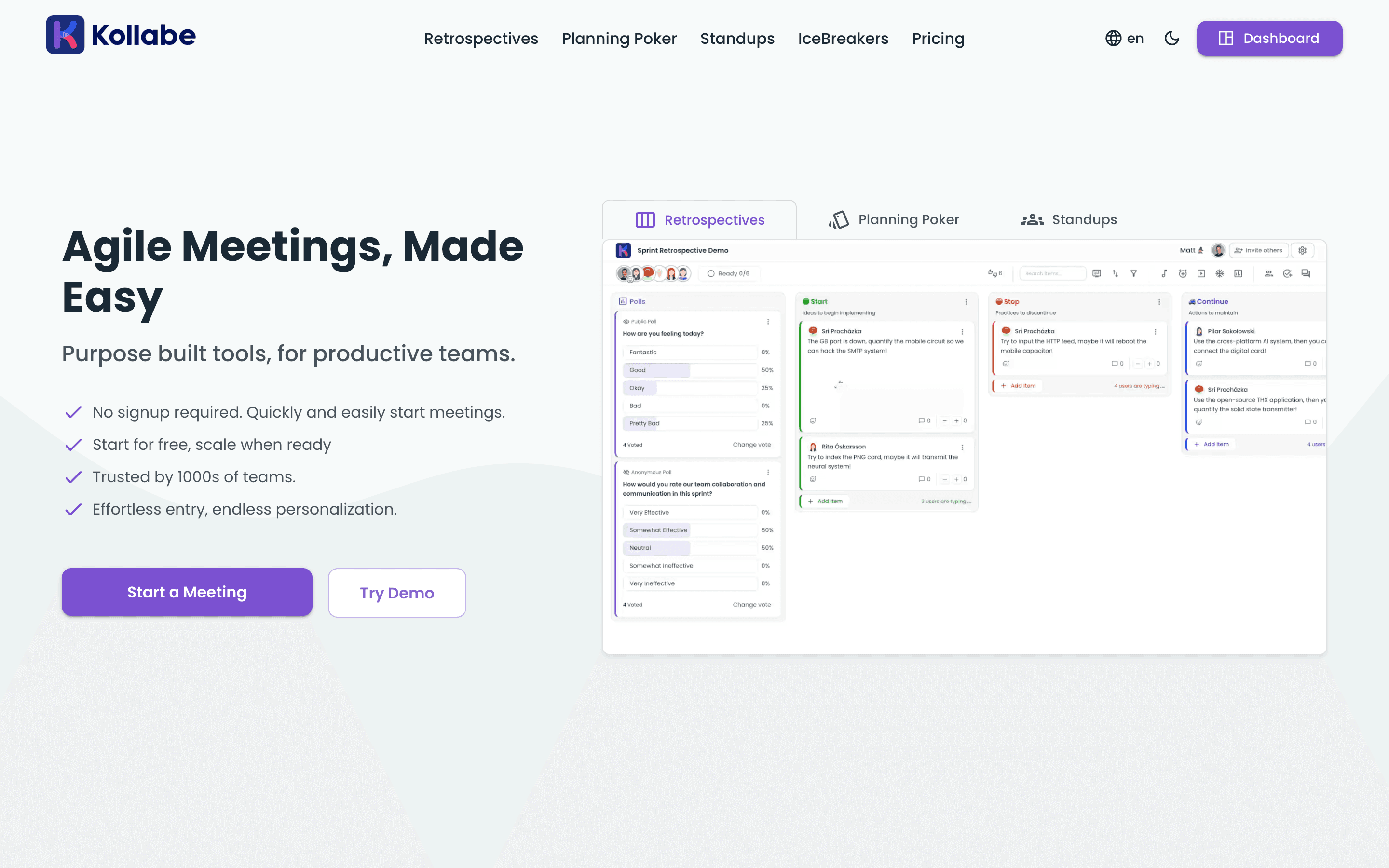
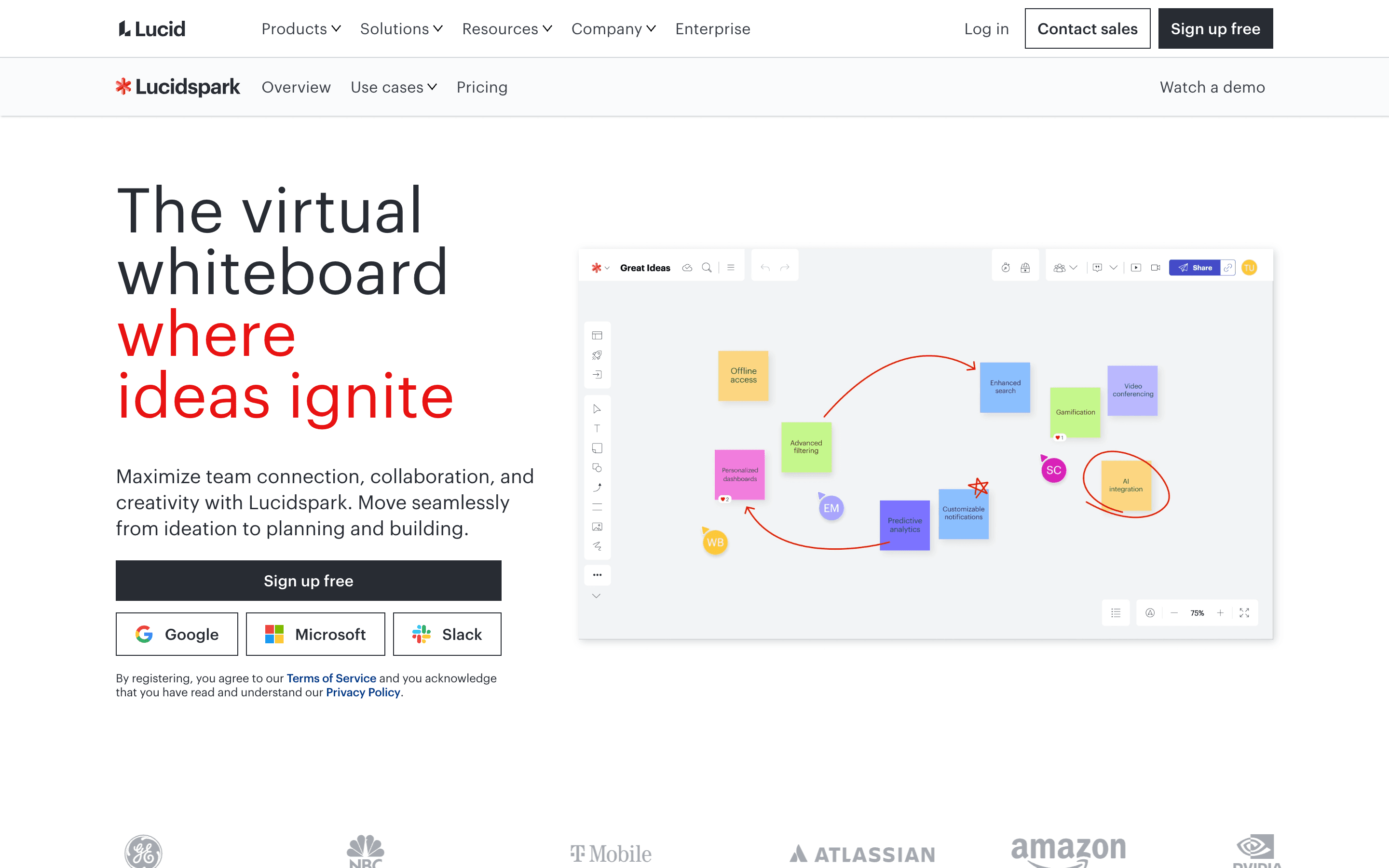
Kollabe is built to run agile ceremonies. Retros, planning poker, async standups, icebreakers. Every screen assumes you're facilitating a meeting with a structure and an outcome. Lucidspark is an enterprise whiteboard, part of the Lucid Suite alongside Lucidchart, that happens to ship 14 retro templates. You can run a retro on it, but you're running it on a blank canvas with sticky notes, not in a tool that knows what a retro is.
For most agile teams, Kollabe wins because it does the actual job: guided phases, AI grouping, sentiment trends, and planning poker that writes estimates back to Jira. Lucidspark earns its place for a different buyer. If your security team requires FedRAMP, if you need a native mobile app, or if your whole org already pays for Lucid and you want one fewer vendor, Lucidspark is the safer call.
Feature Comparison
Both tools cover the retro basics. Anonymous sticky notes, dot voting, a timer, AI grouping, AI summaries, export. On a feature checklist they look closer than they are.
The gap shows up the moment you run a real retro. Kollabe has guided facilitation with phases you can customize, plus async retros where people contribute across timezones before you ever meet live. Lucidspark gives you a template and a facilitator panel, but no step-by-step flow that auto-advances the room through Set the Stage, Brainstorm, Group, Discuss, Actions. You're the one keeping everyone on the same phase, and on a free-roaming canvas that takes effort.
Then there's everything beyond retros. Kollabe has native planning poker with Fibonacci and T-shirt decks, hidden cards, simultaneous reveal, ticket import from Jira/GitHub/Azure DevOps/Linear, and auto estimate sync back to story points. Lucidspark has no real planning poker. Its "Task Estimation" activity lets people estimate effort and view results, but there are no hidden cards and no Fibonacci deck, and estimates don't sync to Jira. Lucid has told its community it's "looking into" planning poker with no timeline.
This is the core difference. Lucidspark is a whiteboard with retro templates. Kollabe is a retro tool. One assumes a blank canvas; the other assumes a ceremony with phases, voting, and action items that carry over to the next sprint.
Standups are similar. Kollabe runs async daily standups with persistent rooms, customizable questions, AI summaries, and analytics. Lucidspark has a standup template, which is a whiteboard with three sticky-note columns. No scheduled prompts, no reminders, no summaries. On templates, Kollabe ships over 1,000 retro templates plus an AI generator that builds a custom board from a theme; Lucidspark has 14 retro templates.
Where Lucidspark genuinely pulls ahead: action items convert to Jira issues with two-way sync, and the infinite canvas beats Kollabe's structured columns for free-form mapping and big multi-team workshops. If your retro is really a sprawling systems-mapping session, the canvas wins.
Pricing Comparison
The pricing models don't line up, so read past the headline numbers.

Kollabe
Flat per team, retros, poker, and standups included
- Unlimited participants and history
- All AI features and integrations included
- Native planning poker and async standups
- Free tier (up to 10 participants)

Lucidspark
Team plan, 3-user minimum, voting and timer start here
- Per user, billed across the team
- Voting and timer gated to this tier
- Native iOS and Android apps
- Free and Individual tiers can't facilitate a retro
Lucidspark's $9 looks cheaper until you notice what's gated. Voting and the timer, the two features you can't run a facilitated retro without, only exist on the Team plan ($9/user/month, 3-user minimum). The Free and $7.95 Individual tiers can't run a proper retro at all. So a 7-person team pays about $63/month on Lucidspark just to vote, and that's still retros only.
Kollabe charges $29/month flat per team for unlimited participants, and that price includes retros, planning poker, and standups. For a team of 7, that's $29 vs roughly $63, and Kollabe throws in two ceremonies Lucidspark doesn't have.
The math flips against Kollabe when you have many small teams. Each Kollabe Space is one team, so 5 teams is 5 × $29 = $145/month. Five Lucidspark seats shared cleverly could undercut that. But if those teams each need poker and standups too, Kollabe is still replacing two or three other subscriptions per team.
Ease of Use
Lucidspark's strength and weakness are the same thing: it's a blank canvas. Powerful, flexible, and reviewers consistently say first-timers find it overwhelming. Boards also get sluggish with a lot of simultaneous participants, which is a real problem in a 12-person retro.
Kollabe is narrower on purpose. You pick a template, the tool walks the room through phases, AI clusters the notes, and you're discussing in minutes. There's less to learn because there's less to do. A new scrum master gets a working retro faster on Kollabe than on a whiteboard they have to lay out themselves.
Both are browser-only with no desktop app. The difference: Lucidspark has native iOS and Android apps (on paid plans), and Kollabe has none. If people join retros from phones, that's a point for Lucidspark.
Integrations
This one's genuinely split.
Lucidspark connects to more of the workplace. Slack, Microsoft Teams, Zoom, Webex, Google Workspace, Confluence, Asana, Smartsheet, Monday.com, plus two-way Jira and Azure DevOps sync via Lucid Cards. If your team lives in Slack or Teams and wants boards shared into channels, Lucidspark already does it.
Kollabe connects to fewer tools but aims them at the dev workflow: Jira, GitHub, Azure DevOps, Linear, and Confluence export. The payoff is depth. Kollabe imports tickets via JQL or WIQL into a poker session and syncs winning estimates straight back to story points. Lucidspark can't do that, because it has no planning poker to sync from.
If Slack or Microsoft Teams notifications are part of how your team works, that's the clearest reason to pick Lucidspark. Kollabe has no Slack or Teams integration at all, which is its biggest connectivity gap.
AI and Automation
Both have AI grouping and AI summaries, and honestly neither is doing anything revolutionary here.
Kollabe's AI reaches across all three ceremonies. Retro summaries take custom instructions, so you can tell it to focus on deployment pain or team morale. Standup summaries roll up daily, weekly, or fortnightly. It also tracks sentiment trends over time and generates whole templates from a prompt.
Lucidspark's Collaborative AI summarizes selected sticky notes and clusters them by attribute (color, tag, emoji, keyword). It's solid, and it plugs into the broader Lucid AI assistant. But it doesn't score sentiment, and like everything else in Lucidspark it stops at the whiteboard. Kollabe has the edge here mostly because its AI works across retros, standups, and poker instead of one canvas.
Who Should Choose Which?
Choose Kollabe if…
- Retros, planning poker, and standups are your main ceremonies and you want one tool
- You need native planning poker with ticket import and auto estimate sync
- You want guided retro phases and fully async retros, not a blank canvas
- Sentiment trends and cross-ceremony AI summaries matter to you
- Flat $29/month beats per-seat pricing for a single focused team
Choose Lucidspark if…
- FedRAMP, SOC 2, and ISO 27001 are hard requirements from your security team
- You need a native mobile app for people joining from phones
- Your team relies on Slack or Microsoft Teams for sharing boards
- You're already in the Lucid Suite and want one fewer vendor
- Your sessions are really free-form mapping or large multi-team workshops
Final Recommendation
If your job is running agile ceremonies, pick Kollabe. It treats retros as retros, gives you real planning poker that syncs to Jira, and adds async standups for one flat price. Lucidspark can host a retro, but you're doing the facilitation work the tool should be doing for you, and you're paying per seat for a canvas that doesn't know what a sprint is.
Lucidspark is the right answer for a specific buyer, and it's a strong one. FedRAMP Moderate authorization is rare in this space, the native mobile apps are real, and the Slack and Teams integrations are things Kollabe simply doesn't have. For an enterprise that needs that security posture, or a team already standardized on Lucid for diagrams and whiteboards, the retro templates are a reasonable bonus on a tool you're already buying.
So the split is clean. Choose Lucidspark for enterprise whiteboarding and compliance. Choose Kollabe to actually run retros, poker, and standups. If you're still deciding what your retros should even look like, our guide to retrospective formats and templates is a good next stop.