

Quick Verdict
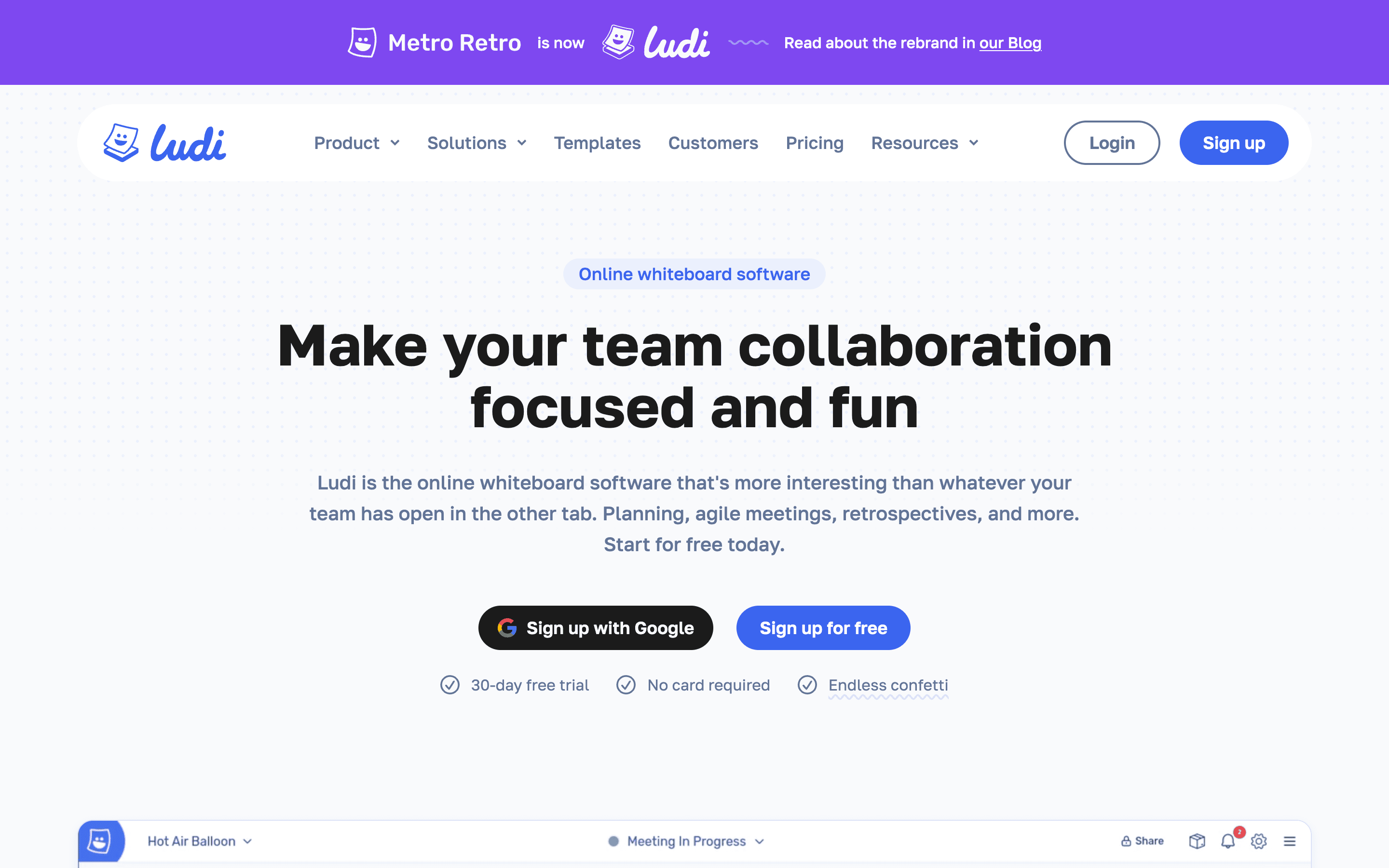
If you want the most fun retro your team will run all quarter, Metro Retro is hard to beat. It is an infinite-canvas whiteboard with hand-drawn templates, gadgets like a confetti cannon and a jukebox, and a playfulness no other tool here matches. It is also cheap to start, at $4 per member per month on the annual Starter plan.
Kollabe wins anyway for most agile teams, and here is the honest reason: it does more, and it does the parts that feed your backlog. Retros, planning poker with ticket import and auto estimate sync, async daily standups, and AI that summarizes and groups every ceremony. Metro Retro has essentially no AI and no standups.
So the split is clean. Choose Metro Retro for creative, freeform visual sessions where the whiteboard is the point. Choose Kollabe when retros are one ceremony in a repeatable sprint cadence and you want the outputs to land in Jira, GitHub, or Linear.
Feature Comparison
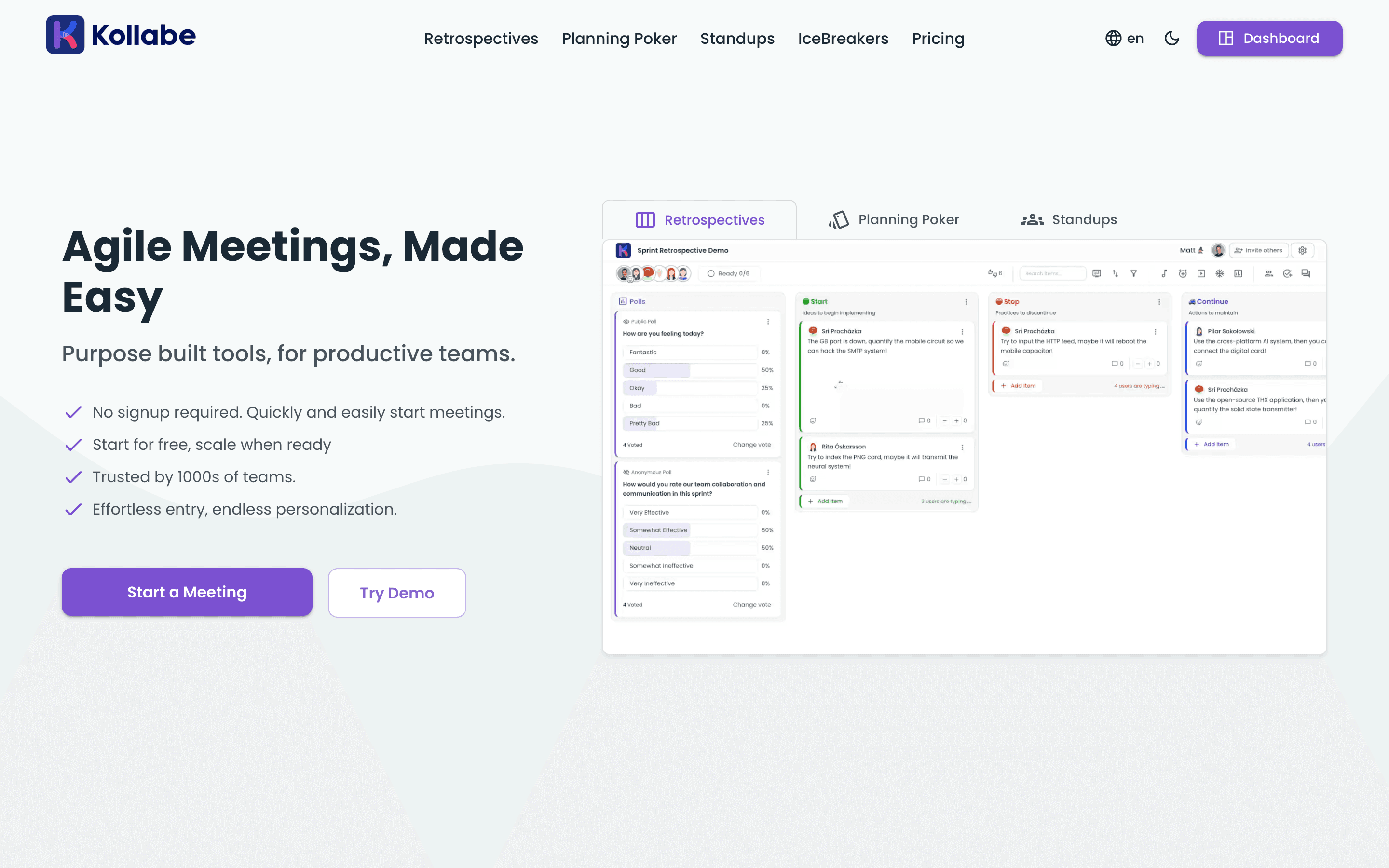
Both tools cover the retro basics well: anonymous mode, dot voting, timers, action items, comments, reactions, and a deep template library. Metro Retro has around 115 hand-illustrated templates across retros, planning, icebreakers, and estimation. Kollabe has over 1,000 plus an AI template generator that builds a custom board from a theme you type in.
The real divergence is breadth. Kollabe is an all-in-one ceremonies platform. Beyond retros it runs planning poker, async daily standups with persistent daily rooms, and 600+ icebreaker questions in six languages. Metro Retro does retros, planning poker, icebreakers, and a few planning formats, but no standups at all and no async meeting mode.
Then there is AI, and this is lopsided. Kollabe has AI summaries you can steer with custom instructions, AI grouping by semantic similarity, sentiment tracking across sprints, and AI-generated PDF reports. Metro Retro has none of these. You group stickies by hand and you read the board yourself.
Metro Retro is the more fun tool, full stop. The infinite canvas, the gadgets, the hand-drawn style — it is the experience people remember. Kollabe trades some of that delight for structure, AI, and outputs that feed your backlog. That tradeoff is the whole comparison.
Action items show the difference in intent. Both create assignable items with due dates. Metro Retro tracks them on a dashboard with email reminders. Kollabe exports them one-click to Jira, GitHub Projects, or Linear, and tracks them between sprints. One keeps the work on the board; the other pushes it into the tools your team already lives in.
Pricing Comparison
This is the one section where Metro Retro can genuinely come out cheaper, so let's do the math honestly.

Kollabe
Flat per team — retros, poker, and standups included
- Unlimited participants and history
- All AI features included
- All integrations included
- Free tier available (10 participants)

Metro Retro
Annual Starter — per member, billed yearly
- Unlimited boards and templates
- Action tracking with reminders
- Business adds Jira + SSO ($6/member)
- No free plan (30-day trial)
Metro Retro prices per member: $4/member/month on annual Starter, $6/member/month on Business (which adds the Jira integration and SSO). Kollabe charges a flat $29/month per Space, with unlimited participants. The crossover point matters. A team of 5 on Metro Retro Business is $30/month, basically the same as Kollabe. A team of 4 on Starter is $16/month, much cheaper. A 12-person team on Business is $72/month, where Kollabe's flat $29 wins easily.
So Metro Retro is cheaper for small teams and Kollabe is cheaper for large ones. Watch out for Kollabe's per-Space model, though: each team is its own $29 subscription, so three teams is $87/month. And note that Metro Retro killed its free plan in September 2024, while Kollabe still has a free tier capped at 10 participants.
For a 4-person team that only needs retros and the occasional poker session, Metro Retro Starter at $16/month is the better-value pick. The price gap only flips in Kollabe's favor once your team grows past 7 or 8 members on a Space.
Ease of Use
Metro Retro is the smoother first session. You drop onto an infinite canvas, grab a template, and start writing stickies. There is no setup ceremony, no phase wizard to configure. The host gets a Meeting Mode with a timer, ready checks, polls, and a one-by-one reveal of private writing. For a quick, frictionless session, it is excellent.
Kollabe is more structured, which cuts both ways. You get guided facilitation phases, voting config, and a clearer step-by-step flow that keeps a distributed team moving together. New scrum masters tend to like the guardrails. People who just want a blank canvas to riff on may find it more rigid than Metro Retro's open whiteboard.
Both run in the browser with nothing to install, and neither has native mobile apps. One caveat for Metro Retro: its whiteboard UI does not translate well to small screens, so phone participation is rough.
Integrations
Kollabe connects to Jira, GitHub, Azure DevOps, Linear, and Confluence, and the depth is the point. For planning poker it imports tickets by JQL (and WIQL for Azure), then syncs the winning estimate back to story points automatically. Action items export to Jira, GitHub Projects, and Linear. That two-way flow is the reason it suits backlog-driven teams.
Metro Retro has one real integration: Jira, on the Business plan. It is genuinely good. Two-way issue import via OAuth with JQL filters, convert stickies to Jira issues, inline editing. But there is no GitHub, Linear, or Azure DevOps integration, and no auto estimate sync back to Jira from poker. GitHub and Slack logins exist for authentication only.
Neither tool integrates with Slack or Microsoft Teams for notifications. Metro Retro and Kollabe both offer those as login providers only. If your team depends on retro summaries or action items landing in a Slack channel, both will disappoint you here.
AI and Automation
This is the most one-sided category. Kollabe runs AI across every ceremony: retro summaries you can customize with your own instructions, semantic AI grouping that clusters related stickies automatically, sentiment analysis that tracks mood over time, an AI template generator, and AI-written PDF reports. Standups get daily, weekly, or fortnightly AI summaries on top.
Metro Retro has no AI features at all. No summaries, no auto-grouping, no sentiment, no AI suggestions. You facilitate and synthesize entirely by hand.
For a facilitator running the same ceremony every sprint, that AI does real work: it skips the manual grouping step and produces a shareable summary the moment the board closes. If you run occasional creative workshops, you may not miss it. If you run retros every two weeks and want repeatable output without the cleanup, Kollabe's automation is the deciding factor.
Who Should Choose Which?
Choose Kollabe if…
- You run retros, planning poker, and standups and want one tool
- You want AI summaries, AI grouping, and sentiment tracking across sprints
- You need ticket import and auto estimate sync back to Jira, Azure, or Linear
- You run async standups or async retros, not just synchronous sessions
- Flat $29/month per team is cheaper once you pass 7-8 members
Choose Metro Retro if…
- You want the most fun, visual retro experience in the category
- Freeform infinite-canvas whiteboarding matters more than rigid structure
- Your team is small (4-5) and $4-6/member is the cheaper option
- You run creative workshops, not just sprint ceremonies
- You only need Jira and can skip GitHub, Linear, and AI
Final Recommendation
For most agile teams running a steady sprint cadence, Kollabe is the buy. One $29/month subscription covers retros, planning poker, and standups, with AI that summarizes and groups across all three and ticket sync that pushes outcomes into your backlog. That breadth is what earns it a higher rating than Metro Retro.
Metro Retro deserves real credit, though. It is the most enjoyable, most visual tool in this roundup, and for small teams it is cheaper. If your retros are creative whiteboard sessions where the canvas and the play are the point, Metro Retro will make people actually look forward to the meeting.
Pick Metro Retro for freeform, fun, visual workshops on a tight budget. Pick Kollabe for repeatable ceremonies that feed Jira and run on AI. If async is your sticking point, our async retrospective guide covers why that gap matters, and you can see where both land in our best retrospective tools list.