

Quick Verdict
These two aren't really competing for the same job.
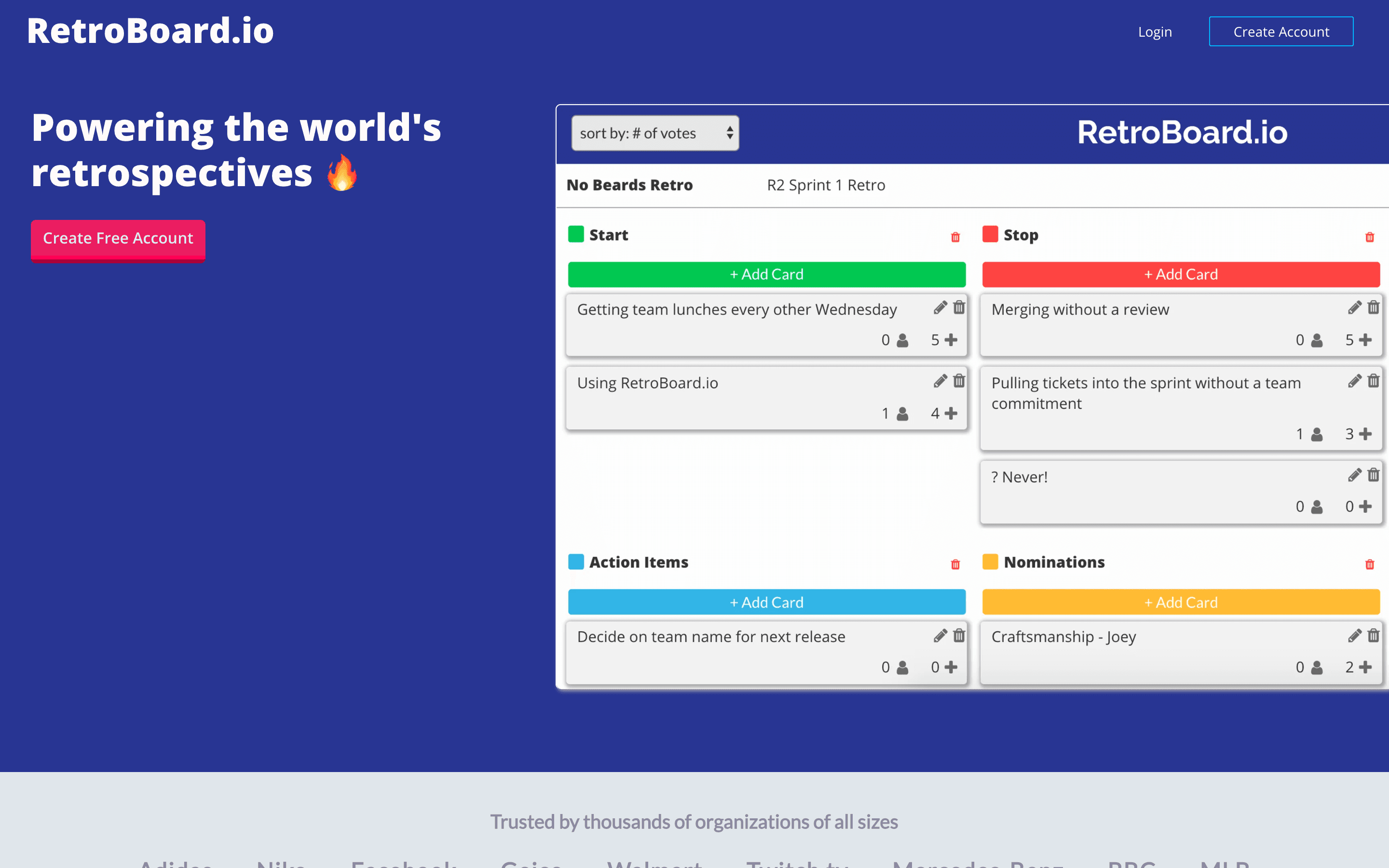
RetroBoard is a free retro board: open it, make columns, add cards, vote, export to CSV. No account needed, nothing to learn, nothing to pay. For a tiny team that just wants somewhere to dump sticky notes once a sprint, that's a legitimate choice and I won't pretend otherwise. It does the one thing it does, and it does it fast.
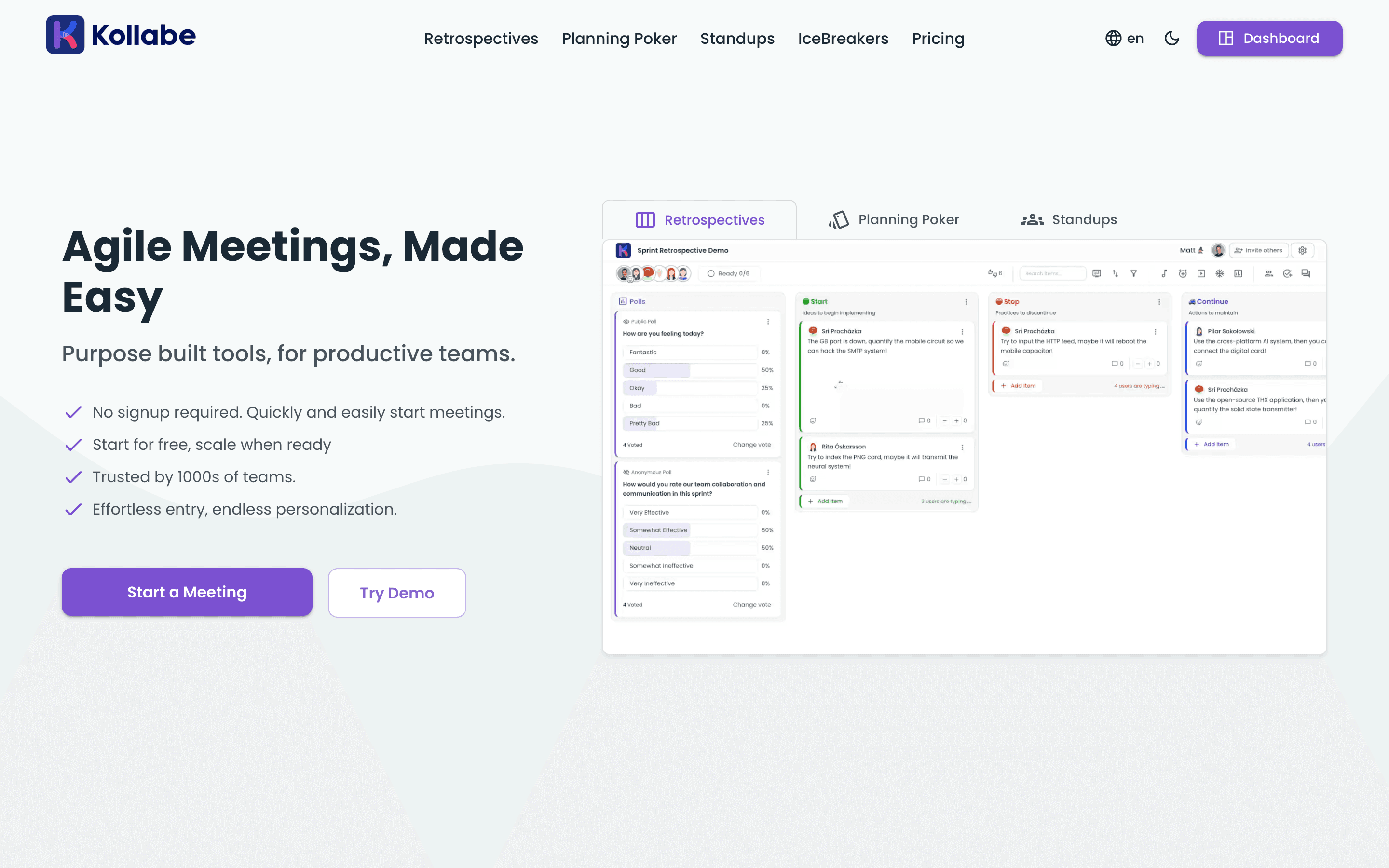
Kollabe is a different category of tool. It runs retros, planning poker, and async standups in one place, with AI grouping, AI summaries, sentiment tracking, action items you can push straight into Jira or Linear, and analytics across sprints. The moment your retro needs to connect to the rest of how the team works, RetroBoard runs out of road and Kollabe keeps going.
So the honest verdict: pick RetroBoard if "a free board with voting" is the whole requirement. Pick Kollabe if the retro is one ceremony inside an actual agile practice.
Feature Comparison
Both tools give you the retro fundamentals: columns, cards, and voting. That's where the overlap ends.
RetroBoard stops at columns and upvotes. Its feature set is short by design: no templates (not even Start/Stop/Continue), no anonymous mode, no timer, no comments or reactions, no card grouping, no action item tracking, and no analytics. The only way data leaves the board is a CSV file. Nothing wrong with that for a quick session, but you're facilitating everything by hand and remembering the outcomes yourself.
Kollabe carries the parts of a retro that usually go missing. Action items get owners and due dates and survive between sprints. AI grouping clusters similar cards by meaning, not just matching words, so you skip the manual affinity-mapping step. AI summaries write up the session, and sentiment analysis tracks team mood over time. There are roughly 1,000 templates plus an AI generator that builds a custom one from a theme you describe.
The real gap isn't features on a checklist. It's what happens after the retro. RetroBoard gives you a CSV and a goodbye. Kollabe assigns action items, tracks them across sprints, and pushes them into Jira, GitHub Projects, or Linear so they don't quietly die in a spreadsheet.
Kollabe also does things RetroBoard never attempts: planning poker with ticket import and estimate sync, async daily standups with AI summaries, 600+ icebreakers, inline polls, themed boards, and six export formats (PDF, Markdown, JPEG, CSV, JSON, Confluence). If you only ever need one CSV column of sticky notes, that's overkill. If you run several ceremonies a week, it's the difference between one tool and four.
Pricing Comparison
This is RetroBoard's strongest card, and it's a real one.

Kollabe
Flat per team — retros, poker, and standups included
- Unlimited participants and history
- All AI features included
- All integrations included
- Free tier (10 participants, 7-day history)

RetroBoard
Free, no account required
- No sign-up to create or join a board
- Columns and upvoting
- CSV export
- No paid tier exists
RetroBoard is free. Not free-tier-with-a-catch free. There's no paid plan, no upsell, no participant cap that I could find. For a side project or a three-person team with zero budget, $0 beats $29 every time, and that's the honest math.
Kollabe has a free tier too (10 participants, 7-day history), but its real value sits at $29/month per Space, billed per team rather than per user. That gets unlimited participants, unlimited history, every AI feature, and every integration. Worth flagging the catch: per-Space pricing means three teams cost 3x ($87/month), so a large org with many small teams can pay more than they'd expect. The trade is that you're replacing a retro tool, a poker tool, and a standup tool with one subscription.
If money is the only axis you're optimizing and you need nothing beyond a board, RetroBoard wins outright. The question is whether "nothing beyond a board" describes your team.
Ease of Use
RetroBoard is about as low-friction as software gets. No login, no setup, no settings to learn. You share a link and people start typing. For a one-off session or a team that distrusts new tools, that near-zero onboarding is a genuine advantage, and it's the main reason RetroBoard still gets used.
Kollabe asks more of you up front. You create an account and a Space, and there are real settings: phases, timers, anonymous toggles, themes, integrations. That's the cost of doing more. The payoff is that AI grouping and summaries remove the manual work that eats the back half of a retro, so the facilitation itself gets easier even though setup takes longer.
If your only worry is "will people actually use it," RetroBoard's no-account, no-learning-curve approach is hard to beat for a first retro. If your worry is "will anything come of this retro," Kollabe's structure is what gets you there.
Integrations
There's not much to compare here, because one side is empty.
RetroBoard has zero integrations. No Jira, no Slack, no GitHub, nothing. CSV export is the only way data leaves the board, and connecting it to anything else is a manual copy-paste job.
Kollabe connects to Jira, GitHub, Azure DevOps, Linear, and Confluence. For retros, the one that matters most is action item export: items flow into Jira, GitHub Projects, or Linear as real issues. For planning poker, you can import tickets (JQL, WIQL, GitHub, Linear) and sync winning estimates back to story points. Be fair about Kollabe's gaps, though: no Slack and no Microsoft Teams, which RetroBoard also lacks, so neither tool posts results to your chat channel.
For a team that lives in a dev tracker, Kollabe's connections are the whole reason action items survive past the meeting. For a team that doesn't use one, the gap matters less.
AI and Automation
This is the cleanest split on the page.
RetroBoard has no AI of any kind. No grouping, no summaries, no sentiment, no generation. It's a manual board, full stop.
Kollabe's AI does the repetitive parts. Grouping clusters cards by meaning so you're not dragging duplicates together by hand. Summaries write the recap, with custom instructions if you want the AI to focus on, say, deployment pain or morale. Sentiment analysis tracks mood across sprints, and the template generator builds a format from a one-line description. None of it is revolutionary, but on a board with 40 cards and 15 minutes left, automatic grouping alone earns its keep.
If AI-assisted facilitation matters to you at all, this isn't really a comparison. Only one tool shows up.
Who Should Choose Which?
Choose Kollabe if…
- You want action items that get owners, due dates, and export to Jira, GitHub, or Linear
- You need AI grouping and summaries to cut the manual work out of facilitation
- You run poker and standups too and want one tool instead of three
- You want 1,000+ templates, an AI generator, and analytics across sprints
- Your retros are part of a real agile process, not a one-off note dump
Choose RetroBoard if…
- You want a completely free board with no paid tier and no upsell
- You need zero setup: no account, just share a link
- A tiny team only needs columns, cards, and upvoting
- You don't need templates, integrations, AI, or action item tracking
- Simplicity and speed matter more than what happens after the retro
Final Recommendation
For most agile teams, Kollabe is the clear choice. It treats the retro as a step that should produce tracked, assigned, exported outcomes, and it backs that up with AI grouping, summaries, planning poker, and async standups in one subscription. RetroBoard gives you a board and a CSV, and everything after the meeting is on you.
But I'd be lying if I said RetroBoard has no place. For a three-person team, a hobby project, or anyone who wants a free board with no account and no learning curve, it does exactly that and asks for nothing in return. Free and instant is a real feature, and Kollabe is genuinely more than that team needs.
So: choose RetroBoard if a free, zero-setup board with voting is the entire requirement. Choose Kollabe if you want the retro to actually change how the next sprint goes. And if you want help making retros stick, our guide on why action items never get done is a good place to start.