

Quick Verdict
These two tools are aimed at different people. That's the whole story.
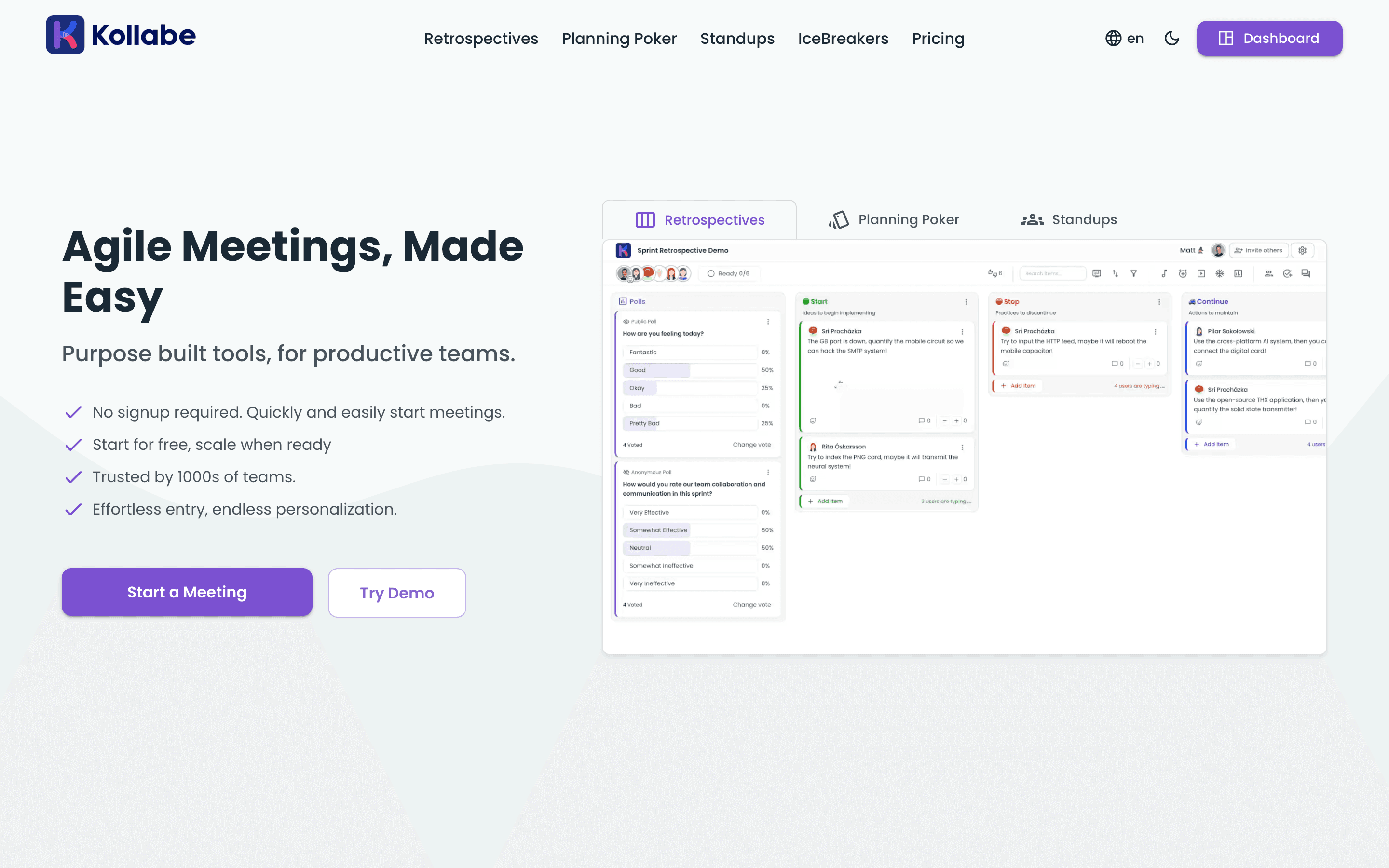
Kollabe is built for scrum masters and teams who run the full ceremony cycle. Retros, planning poker, daily standups, icebreakers, all in one subscription. The retro side is deep: over 1,000 templates, an AI template generator, themed boards, inline polls, a drawing canvas, and six export formats. If your week includes more than just retros, Kollabe covers it for $29/month flat per team.
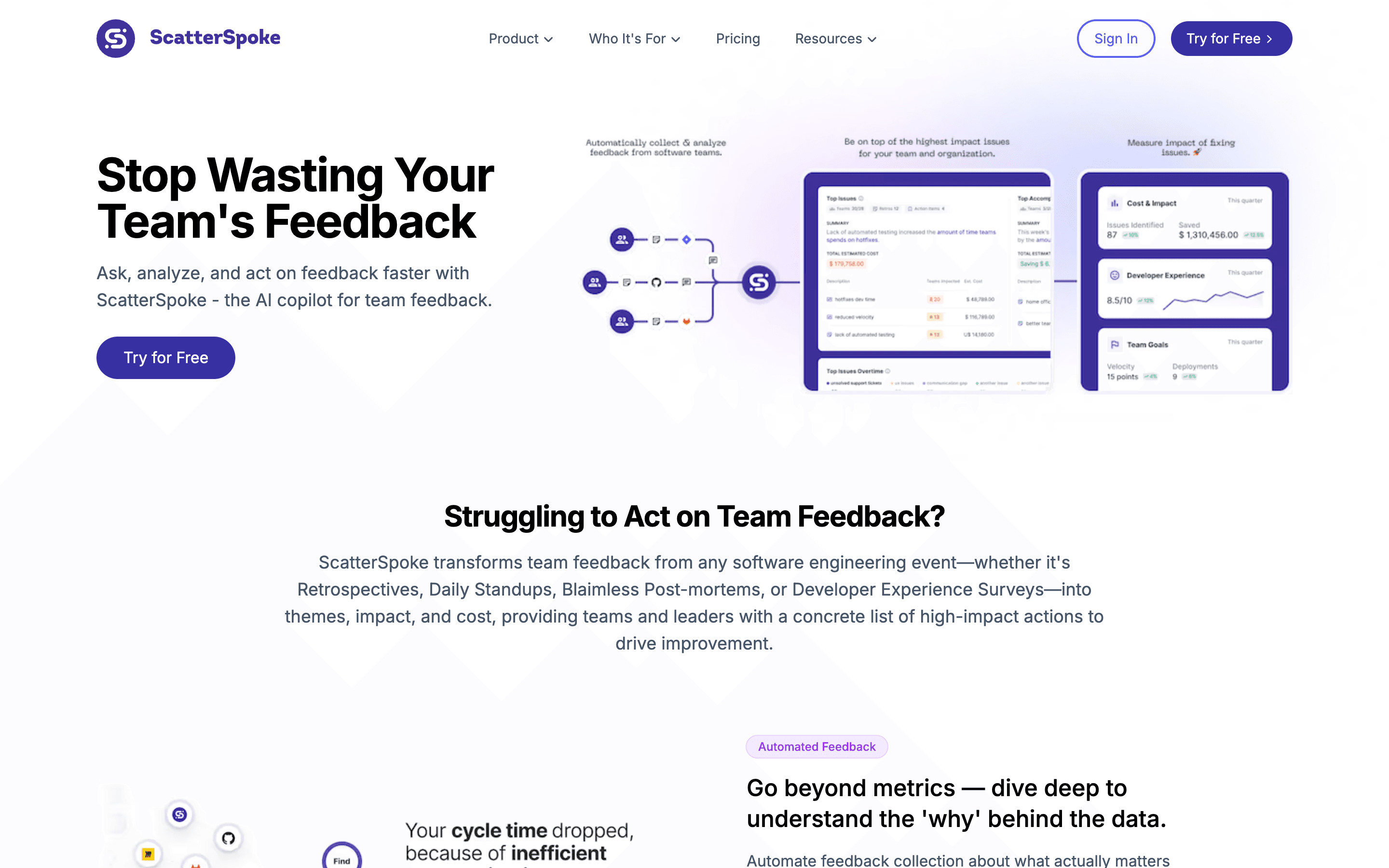
ScatterSpoke is built for engineering leaders who treat retrospectives as a data source. It pulls metrics from Jira, GitHub, and Bitbucket, runs sentiment analysis by theme, and rolls everything into executive dashboards that quantify your "Top Issues" over time. It's SOC 2 Type II certified and delivers retros and standups through Slack, Microsoft Teams, or email. For a director who wants trend lines, not just sticky notes, that's the pitch.
Kollabe wins for most agile teams because it does more of what those teams actually do week to week. But if dashboards, engineering insights, and compliance are your top three, ScatterSpoke is the honest answer.
Feature Comparison
On the core retro mechanics, both tools are solid. Anonymous cards, voting, timers, action items, guided facilitation, AI summaries, sentiment analysis. You can run a clean retro in either.
The depth diverges fast. Kollabe ships roughly 1,000 templates plus an AI generator that builds a custom board from a theme or goal. ScatterSpoke offers around 19 to 20 retro formats. Kollabe also has the extras facilitators actually reach for mid-session: inline polls any member can launch, a drawing tool, 30 themed backgrounds, kudos, GIF and image support, and AI grouping by semantic similarity. ScatterSpoke has no automated grouping at all, so clustering cards is manual.
ScatterSpoke earns its keep on the analytics side. Its sentiment analysis splits feedback by theme (people, process, product) and tracks it across retros. The executive dashboard surfaces recurring issues and tries to quantify their impact, which is exactly what an engineering director wants in a quarterly review. Kollabe has participation analytics and sentiment trends, but no dedicated cross-retro dashboard that shows whether a specific theme improved over six sprints.
The real split: ScatterSpoke turns retros into reporting. Kollabe turns one subscription into your whole ceremony stack. ScatterSpoke's executive dashboard with theme-level sentiment trends has no Kollabe equivalent. Kollabe's planning poker, async standups, and 1,000+ templates have no ScatterSpoke equivalent.
The biggest gap is scope. Kollabe runs planning poker with Jira, GitHub, Azure DevOps, and Linear ticket import plus auto estimate sync, async daily standups with AI summaries, and 600+ icebreaker questions. ScatterSpoke does retros and AI-powered async standups, and that's it. No planning poker, no estimation. If you need to size a backlog, ScatterSpoke can't help.
Pricing Comparison
Both tools price by team rather than per user, but the tiers tell different stories.

Kollabe
Flat per team — retros, poker, and standups included
- Unlimited participants and history
- All AI features and integrations included
- Every ceremony type in one plan
- Free tier (10 participants, 7-day history)

ScatterSpoke
Starter — 5 teams, 100 users, 2 integrations
- 100 AI reports/month, 6-month history
- SOC 2 reports require the $300 Business plan
- SSO only on Enterprise (custom pricing)
- Free tier (1 team, 10 users, 90-day history)
At the entry level the prices are nearly identical: $29 vs $30. But Kollabe's $29 unlocks everything, including unlimited integrations and unlimited history. ScatterSpoke's $30 Starter caps you at 2 integrations and 6 months of history.
Here's the catch for ScatterSpoke's own audience. The two features that make it worth choosing, SOC 2 reports and cross-team summaries, live on the $300/month Business plan. SSO and custom data controls are Enterprise only. So the engineering org most likely to want ScatterSpoke for compliance reasons is also the one that has to jump to $300/month to get the compliance paperwork.
Kollabe's pricing has its own wrinkle. Each Space is one team, so three teams means three subscriptions, $87/month. ScatterSpoke's Starter covers 5 teams for $30. For a company with many small teams that only need retros, ScatterSpoke is genuinely cheaper. Run the headcount math before you commit.
Ease of Use
Both tools guide a facilitator through a structured retro, and both let any team member lead with AI assistance. Neither is hard to learn.
Kollabe gives the facilitator more to work with during the session. AI grouping removes the manual clustering step. Inline polls let you take the temperature of the room without leaving the board. Themed backgrounds and the drawing tool make remote retros feel less sterile. For a scrum master who runs retros every sprint, those touches add up.
ScatterSpoke is leaner by design. Fewer formats, no grouping automation, but a clean guided flow and a real strength most tools skip: you can run the whole thing from Slack or Teams. Team members drop feedback from where they already work instead of opening another tab. For distributed engineering teams that live in chat, that lowers the friction more than any in-board feature.
Integrations
This is where ScatterSpoke clearly leads, and it matters for its audience.
ScatterSpoke connects to Slack and Microsoft Teams for both retro feedback and standup responses, pulls metrics from Jira, GitHub, and Bitbucket to feed its AI insights, and exports action items to Jira and Trello. The chat-tool delivery is the headline. Standups and feedback collection happen inside Slack or Teams, no separate login required.
Kollabe goes narrower but deeper on dev tools. Jira, GitHub, Azure DevOps, and Linear all support two-way sync: JQL or WIQL ticket import into planning poker, auto-sync of estimates back to story points, and action item export. It also exports retro results to Confluence. That two-way estimate flow is something ScatterSpoke can't match, because it doesn't do estimation.
Kollabe has no Slack and no Microsoft Teams integration, full stop. ScatterSpoke runs retros and standups directly inside both. If your team's workflow depends on chat-tool delivery, that's a real gap Kollabe hasn't closed, and it's a legitimate reason to pick ScatterSpoke.
So the integration winner depends on what you mean by integration. For chat delivery and metrics ingestion, ScatterSpoke. For two-way ticket and estimate sync across four dev tools, Kollabe.
AI and Automation
Both tools lean on AI, but they point it in different directions.
ScatterSpoke aims its AI at engineering signal. The Retrospective Copilot identifies critical topics and generates summaries with takeaways. The Stand Up Copilot asks contextual questions and flags blockers. Sentiment analysis runs by theme and trends over time, and the system blends in coding-activity data from GitHub and Bitbucket. For a leader who wants to spot patterns across teams, that's the strongest part of the product. Pair it with the right retro metrics and you have something you can actually put in front of a VP.
Kollabe spreads its AI across every ceremony instead of one. Retro summaries are customizable with your own AI instructions, so you can tell it to focus on deployment pain or morale. Standup summaries run daily, weekly, or fortnightly. AI grouping clusters cards by meaning, and the AI template generator builds boards on demand. It's broad and practical rather than analytics-first.
Honestly, neither is doing anything revolutionary with AI. ScatterSpoke goes deeper on metrics and trend detection. Kollabe goes wider, applying AI to retros, standups, and template creation alike.
Who Should Choose Which?
Choose Kollabe if…
- You run retros, planning poker, and standups and want one tool instead of three
- You need planning poker with ticket import and auto estimate sync
- You want a deep retro toolkit: 1,000+ templates, AI generator, themed boards, inline polls, drawing tool
- Flat $29/month covers every ceremony with all AI and integrations included
- You sync with Jira, GitHub, Azure DevOps, or Linear two ways
Choose ScatterSpoke if…
- You want executive dashboards and theme-level sentiment trends across teams
- SOC 2 Type II certification is a hard requirement
- Your team runs retros and standups inside Slack or Microsoft Teams
- You want AI insights fed by GitHub and Bitbucket coding-activity data
- You manage several small teams and want them on one Starter plan
Final Recommendation
For most agile teams, Kollabe is the better buy. One $29/month subscription runs retros, planning poker, standups, and icebreakers, and the retro toolkit goes deeper than almost anything in this category. If your sprint cadence involves more than retrospectives, paying for one tool instead of three is the obvious call.
ScatterSpoke is not a weaker tool, it's a different one. It's purpose-built for engineering leaders who want retros to produce data: sentiment by theme, recurring issues quantified, trends across teams, all delivered through Slack or Teams and backed by SOC 2. Kollabe has none of that chat delivery, no SOC 2 certification, no cross-team trend dashboard, and its data lives only in Australia with no residency options. Those are real gaps for a compliance-minded org.
Pick Kollabe if you want one platform for every ceremony with strong hands-on facilitation. Pick ScatterSpoke if dashboards, engineering insights, and compliance sit at the top of your list. Match the tool to who's actually buying it, and the choice gets easy.