

Quick Verdict
These two tools are aiming at different problems.
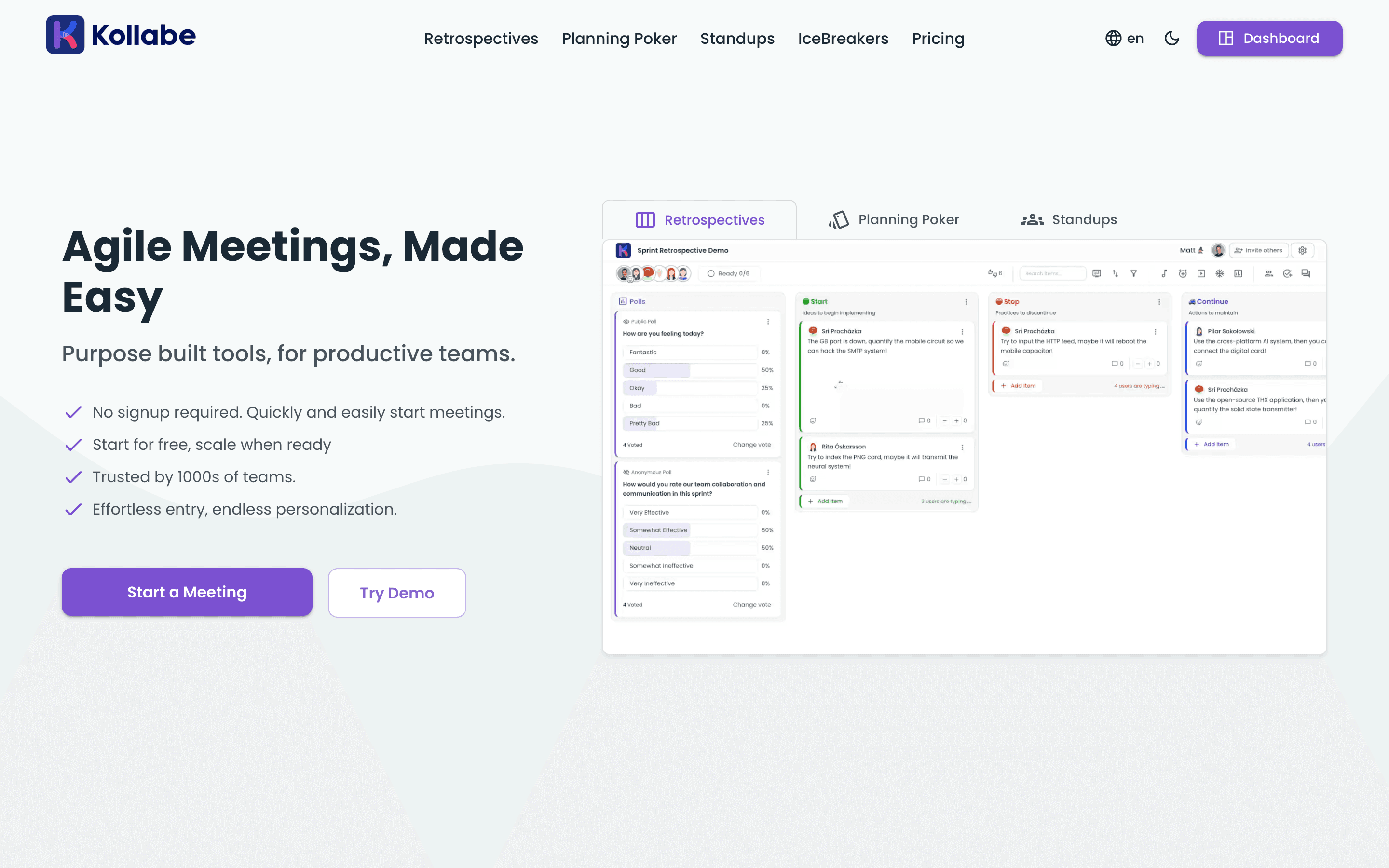
Kollabe is an all-in-one agile platform: retrospectives, planning poker, async daily standups, and icebreakers under one $29/month subscription. Sprintlio is a retro tool with a sharp focus on one thing, which is driving action items to completion and pulling the whole workflow into Slack. If your retros produce action items that quietly die every sprint, Sprintlio is built to fix exactly that, and its Slack integration is genuinely good.
For most teams, though, Kollabe wins on breadth and price. You get three ceremonies instead of one, deeper AI, and over 1,000 templates, all for less than Sprintlio's $50/month Pro plan. Sprintlio earns its place if Slack is your team's home and follow-through is the only problem you're solving.
Feature Comparison
On the retro board itself, the gap is smaller than the ratings suggest. Both do anonymous cards, dot voting, timers, comments, custom formats, and CSV export. Sprintlio holds its own here.
Where they split is scope. Kollabe runs planning poker (with Jira, GitHub, Azure DevOps, and Linear ticket import plus auto estimate sync) and async daily standups with AI summaries. Sprintlio does neither. No poker, no standups, no icebreakers. It's a retrospective tool, full stop.
Sprintlio's real strength is action-item tracking. You assign owners and due dates, auto-export items to Jira, and the analytics dashboard tracks completion rates over time so you can actually see how many items closed versus how many got dropped. That accountability loop is the product's whole reason for existing, and it's better at surfacing follow-through than most tools.
Sprintlio is purpose-built for the retro-to-action gap. If your team's pattern is "great discussion, nothing changes by next sprint," its completion tracking and Slack due-date reminders directly target that. Kollabe assigns owners and exports to Jira, GitHub, and Linear, but it doesn't have the same dedicated "did this item actually close?" reporting.
Kollabe counters with depth across the board: over 1,000 templates plus an AI template generator, 30 themed retro backgrounds, inline polls, a drawing canvas, kudos, and export to PDF, Markdown, JPEG, CSV, JSON, and Confluence. Sprintlio exports to CSV, email, and Slack only, with no PDF. Kollabe also supports fully async retros, which Sprintlio does not.
Pricing Comparison
This is the clearest gap between the two, and it runs in Kollabe's favor.

Kollabe
Flat per team — retros, poker, and standups included
- Unlimited participants and history
- All AI features included
- Retros + poker + standups
- Free tier available (10 participants)

Sprintlio
Pro plan, flat per team — retros only
- Unlimited users and meetings
- Action item tracking + analytics
- Jira and Slack integration
- Cheaper Standard plan around $25/mo
Both charge a flat rate per team rather than per user, so neither punishes you for adding people. The difference is what you get for the money. Kollabe's $29 Premium plan covers three ceremony types. Sprintlio's $50 Pro plan covers one.
Sprintlio does have a Standard plan reported around $25/month, which undercuts Kollabe on paper. But the feature limits on that tier aren't clearly documented, and the full action-item, analytics, and integration set sits on the $50 Pro plan. There's also no enterprise tier at all. No custom contracts, no SSO/SAML beyond its Auth0 login, no SLA. If you're an org that needs procurement to sign off, Kollabe's Enterprise plan gives you a path that Sprintlio doesn't.
Ease of Use
Both tools are browser-based with nothing to install, and both keep the retro board itself approachable. A facilitator new to either will find the cards-and-voting flow familiar within a session or two.
Sprintlio leans on Slack to lower friction. You can manage meetings, cards, and action items without leaving Slack, and it sends automated recaps and due-date reminders into your channels. For a team that already lives in Slack, that's less context-switching and a real reason to like it.
Kollabe's facilitation is more guided inside the app, with customizable workflow phases and AI grouping that skips the manual clustering step. The tradeoff is that everything happens in Kollabe. There's no Slack surface to pull it into. Which approach feels easier depends entirely on where your team already spends its day.
Integrations
Sprintlio keeps its integration list short and deliberate: Jira and Slack. Action items auto-sync to the Jira backlog with owners and due dates, and the Slack integration is the deepest part of the product. For a Jira-and-Slack shop, that covers the essentials.
Kollabe connects to more dev tools — Jira, GitHub, Azure DevOps, Linear, and Confluence — and goes two-way. It imports tickets for planning poker via JQL and WIQL, syncs winning estimates back to story points, and exports action items to Jira issues, GitHub Projects, and Linear. That range matters more for teams that don't run everything through Jira.
Kollabe has no Slack integration. None. Sprintlio does, and it's central to how Sprintlio works — recaps, reminders, and action-item management all flow through Slack channels. If your team's outcomes need to land in Slack automatically, that's a real gap in Kollabe, and one of the few places Sprintlio clearly beats it.
Neither tool integrates with Microsoft Teams, and Sprintlio has no GitHub, Linear, or Azure DevOps support at all.
AI and Automation
This is where the ratings gap shows. Kollabe has built out AI across its ceremonies; Sprintlio has essentially none.
Kollabe does AI grouping by semantic similarity, AI summaries you can steer with custom instructions, sentiment analysis that tracks mood trends, and an AI template generator that builds a custom format from a theme or goal. Those features run across retros and standups, not just one board.
Sprintlio has no AI summaries, no AI grouping, and no sentiment analysis. Its "insight" comes from analytics — completion rates, participation, voting patterns, team health scores over time — which is useful, but it's reporting, not generative AI. Grouping is manual. If AI-assisted facilitation matters to you, this is a one-sided category.
Who Should Choose Which?
Choose Kollabe if…
- You want retros, planning poker, and async standups in one tool
- You need ticket import and auto estimate sync for poker sessions
- AI grouping, summaries, and sentiment analysis matter to your facilitation
- Flat $29/month beats Sprintlio's $50 Pro plan for more ceremonies
- You need an enterprise path with SSO/SAML and custom contracts
Choose Sprintlio if…
- Your team lives in Slack and wants recaps and reminders there
- Action items dying between sprints is your single biggest problem
- You want completion-rate tracking and team health scores over time
- You run only retros and don't need poker or standups
- Jira is your backlog and you don't need GitHub, Linear, or Azure DevOps
Final Recommendation
For most agile teams, Kollabe is the better buy. One $29/month subscription replaces a separate retro, poker, and standup tool, and its AI does more of the grouping and summarizing work that eats facilitation time. Against a retro-only tool that starts at $50, the value math isn't close.
Sprintlio is not a weak product, though. Its 3.4 rating undersells how good it is at the one thing it cares about. If your retros consistently generate action items that nobody finishes, and your team already runs on Slack, Sprintlio's completion tracking and channel-native reminders target that pain better than Kollabe does. The honest tradeoff: Kollabe has no Slack integration, so if that's where your work happens, weigh it carefully.
Pick Kollabe if you want one platform for all your ceremonies with AI doing the heavy lifting. Pick Sprintlio if Slack is home and follow-through is the only problem worth solving. And if you want to dig into why that problem is so common, our guide on why retro action items never get done is worth a read.