

Quick Verdict
This is a different kind of comparison. Miro is a visual collaboration platform that happens to do retros. Parabol is a purpose-built agile ceremony tool that does retros, planning poker, and standups — and nothing else.
If your team already uses Miro for brainstorming, diagramming, or workshops, adding retros to the same platform avoids another login. Miro's 160+ integrations and native apps on every device make it hard to beat on convenience alone.
But if you want a tool that actually guides your facilitator through the retro step by step — Reflect, Group, Vote, Discuss — Parabol does that. Miro doesn't. For teams where facilitation quality matters more than whiteboard flexibility, Parabol is the stronger retro tool.

Feature Comparison
Both tools cover the retro basics: anonymous feedback, voting, timers, action items, real-time collaboration. What actually separates them is structure versus flexibility.
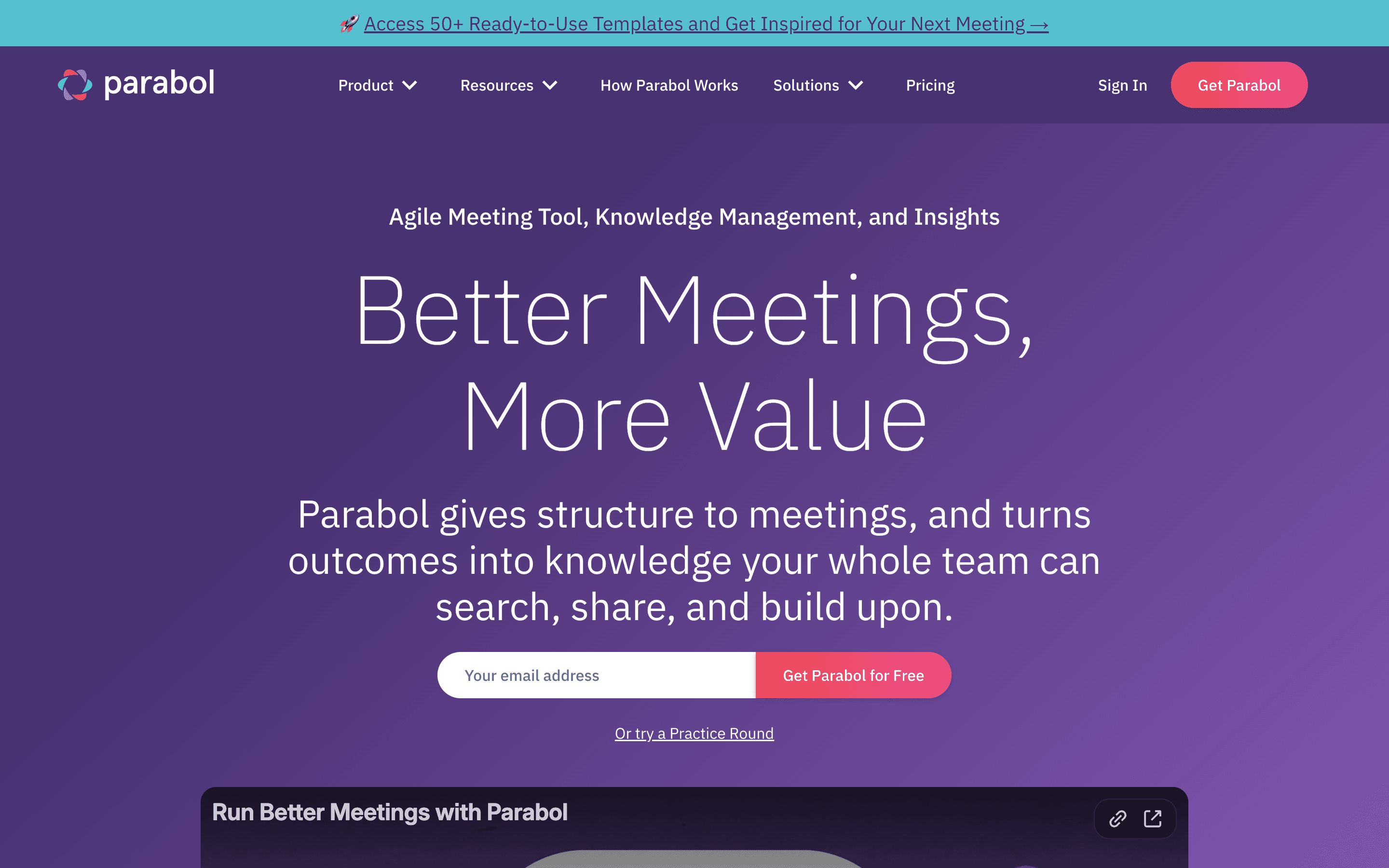
Parabol runs retros as a guided sequence. The facilitator advances through phases — everyone writes reflections, then the team groups cards, then votes, then discusses the top-voted items. Each phase has its own timer. The tool enforces the flow so the facilitator doesn't have to. It also carries action items forward between meetings automatically, which keeps accountability from falling through the cracks.
Miro gives you a blank canvas with a retro template on it. You get sticky notes, voting dots, and a timer, but orchestrating the session is entirely on you. There's no concept of "phases" — participants can vote before everyone has finished writing, or start grouping cards while others are still adding them. For experienced facilitators, that freedom is fine. For rotating facilitators or teams new to retros, the lack of guardrails shows.
Parabol's guided facilitation isn't just a UX preference. It prevents the most common retro failure mode: the loudest voice dominates because there's no enforced silent writing phase. Miro's private mode helps, but the facilitator has to manually manage the reveal and transition.
Miro goes far wider beyond retros. Its Estimation app handles planning poker with Fibonacci decks and anonymous voting. It has Lean Coffee templates, PI Planning boards, and 7,000+ community templates in Miroverse. Parabol covers retros, poker, and standups. Three ceremonies done well rather than an entire whiteboard ecosystem. Both tools support health checks, though Parabol's are built in (paid plans) while Miro relies on community templates with emoji voting.
Pricing Comparison
Both charge per user per month, but Parabol's model has a twist that saves money.

Miro
Starter plan, billed annually
- Unlimited boards and visitors
- 25 AI credits/month per user
- 160+ integrations
- Free plan: 3 boards, 10 AI credits/team

Parabol
Team plan — inactive users excluded
- Unlimited teams and meetings
- AI summaries and grouping included
- Open-source (self-host for free)
- Free plan: 2 teams, 10 meetings/month
Same sticker price, very different economics. Parabol only charges for users who were active in the last 30 days. A team of 12 where 3 people skip a sprint cycle? You pay for 9. Miro charges for every seat whether they logged in or not.
Miro's AI runs on credits that reset monthly and burn faster on complex operations. Parabol includes AI summaries and grouping on paid plans without a visible credit system. And because Parabol is open source under AGPL v3, you can self-host it for free if you have the infrastructure — something Miro will never offer.
The catch: Miro's free plan gives you 3 boards with unlimited team members. Parabol's free plan limits you to 10 meetings per month with only 30 days of history. Neither free tier is great for ongoing use.
Ease of Use
Miro's canvas is familiar. If you've used any digital whiteboard, you already know the basics — drag sticky notes, dot-vote, draw connections. 100 million users mean there's no shortage of YouTube tutorials and community resources. The downside is that retros on Miro feel like retros on a whiteboard, because that's what they are. The facilitator does all the work.
Parabol's interface is more opinionated. There's really only one thing to do at each step: write your reflections, then group, then vote, then discuss. New facilitators don't have to figure out when to advance. The tool handles it. You lose the ability to rearrange a canvas or run brainstorming sessions, but most teams don't need that during a retro anyway.
Miro has native apps on iOS, Android, macOS, and Windows. Parabol is web-only with a responsive mobile layout. If your team frequently joins retros from phones or tablets, Miro's native apps are a real advantage.
Integrations
Miro has 160+ apps in its marketplace. Jira and Azure DevOps get two-way sync. GitHub, Linear (beta), Confluence, Slack, Microsoft Teams, Trello, Google Workspace, Zoom, Figma — the list goes on. If your team uses it, Miro probably connects to it.
Parabol's integration list is smaller but covers the essentials: Jira (Cloud and Data Center), GitHub, GitLab, Azure DevOps, Linear, Slack, and Microsoft Teams. Action items from retros sync directly to your backlog tool. Planning poker estimates write back to Jira story points automatically. The integrations are deeper for agile workflows even if there are fewer of them.
Parabol is the only tool in this comparison that integrates with GitLab — both Cloud and self-managed. If your team tracks work in GitLab, that narrows the field fast.
Where Parabol falls short: no Trello, no Confluence import, and no Google Workspace integration. Miro's breadth is hard to match.
AI and Automation
Both tools have AI clustering and summaries. Neither is a clear winner here.
Miro's AI groups sticky notes by color, tag, keyword, and sentiment. It can summarize board activity with its "Catch-up" feature. But AI consumes credits: 10/month on the free plan, 25 on Starter, 50 on Business. Users report credits running out mid-session on larger boards. For a 20-person retro generating 100+ cards, that ceiling bites.
Parabol's AI auto-names groups and generates meeting summaries on paid plans (3 free summaries on Starter). No credit system, so you won't hit a wall mid-session. Enterprise customers can disable AI entirely if their data policies require it.
Neither tool will suggest discussion topics or write action items for you. Once the cards are grouped, both still rely on the facilitator to drive the conversation. Kollabe pushes further on AI-assisted facilitation if that's what you're after.
Who Should Choose Which?
Choose Miro if…
- Your team already uses Miro for brainstorming, diagramming, or sprint planning
- You need native mobile and desktop apps for team members joining from different devices
- Your tech stack requires 160+ integrations and you can't afford gaps
- You want one platform for retros, workshops, PI planning, and everything in between
- SOC 2 and ISO 27001 certification are non-negotiable for your security team
Choose Parabol if…
- Your facilitators rotate or are new and need guided step-by-step retro flow
- You want to pay only for users who actually showed up this month
- Open source matters — you want to self-host or audit the code yourself
- Your team uses GitLab and needs native integration support
- You run retros, poker, and standups and want all three in a purpose-built tool
For more on how these tools compare to other options, see our guides on retrospective formats and how to run a great retrospective.
Final Recommendation
Miro is the safer pick for most organizations. Your team probably already knows it. It has native apps on every platform, SOC 2 and ISO 27001 on the security checklist, and 160+ integrations that probably cover whatever your stack looks like. If retros are just one of many things you do on a whiteboard, Miro handles that without adding another subscription.
Parabol is the better retro tool. Guided phases produce more structured retros, especially when the facilitator role rotates. You only pay for people who actually show up, and you can self-host the whole thing if you want to. No other tool on this list gives you that kind of control. If retro quality is what you're optimizing for, Parabol earns the edge.
The honest answer: if you already pay for Miro, run your retros there. If you're choosing fresh and retros are a priority, try Parabol first.