

Quick Verdict
Retrium and TeamRetro both walk facilitators through retros step by step. That's about where the overlap stops.
TeamRetro has spent the last year shipping hard: AI grouping, sentiment analysis, planning poker, health check maturity models, Jira two-way sync, Notion integration. Retrium hasn't released a major feature since its Slack integration in late 2023. At $39/month per team room, that pace is tough to justify.
Pick Retrium if your team needs truly async retros across time zones, or if you're locked into an enterprise contract and switching costs don't pencil out. For everyone else, TeamRetro does more for less.
Feature Comparison
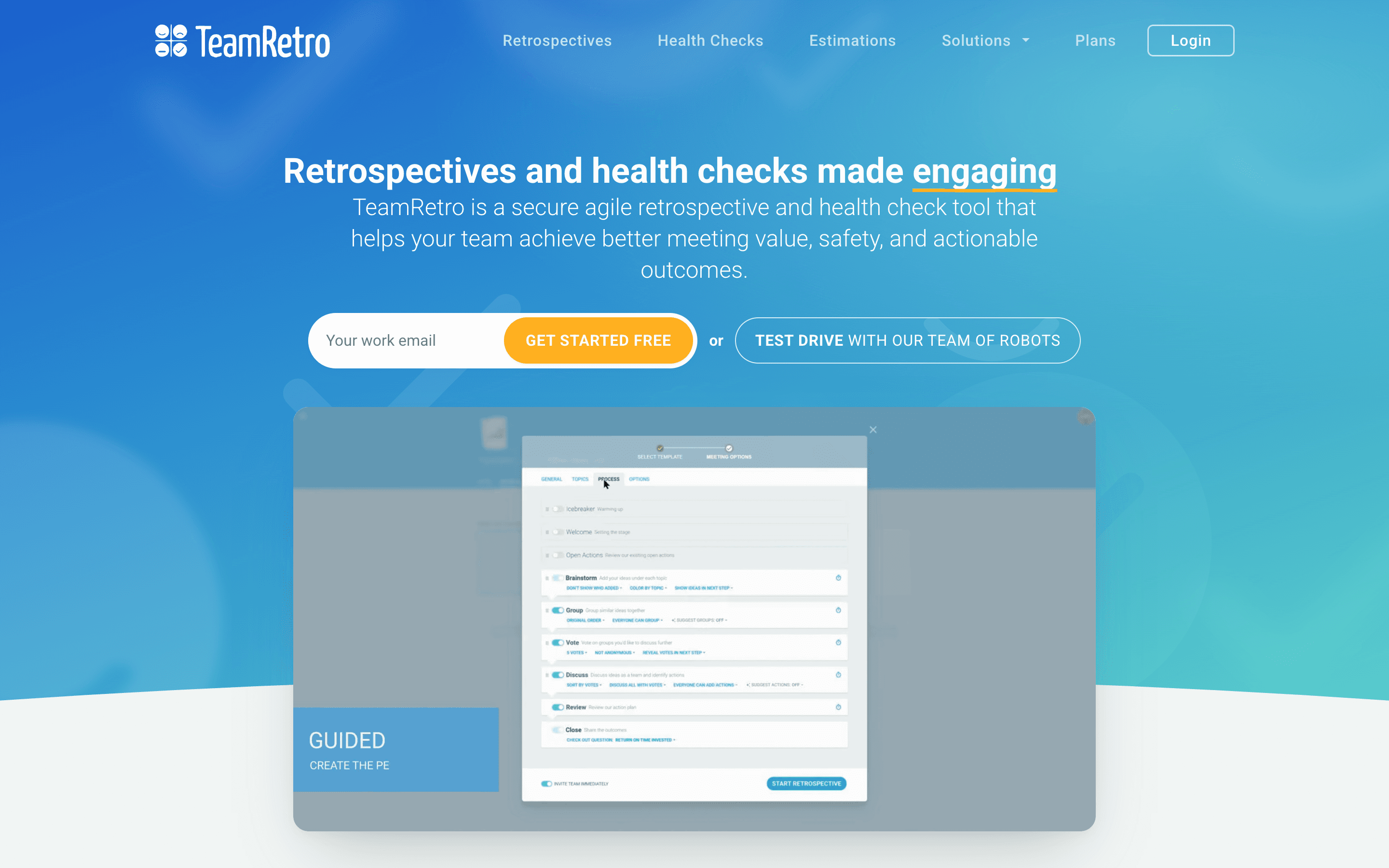
These tools share DNA. Both use a phased facilitation model (brainstorm, group, vote, discuss, wrap up) with anonymous feedback and facilitator-controlled progression. Both have health check features. Both support Lean Coffee as a built-in technique.
Where they split is everything around the retro itself.
TeamRetro layers AI onto every phase. Cards get auto-grouped into themes during affinity mapping. Post-meeting summaries generate automatically. Sentiment analysis builds heat maps and trend lines across retros and health checks. AI-generated icebreakers kick off sessions. Beyond retros, there's planning poker with six estimation decks and standalone health checks with four pre-built models plus 15 maturity templates added in January 2026. The team has been busy: @mentions, kudos badges, quick polls, GIF support, and a Notion integration all shipped in the last year.
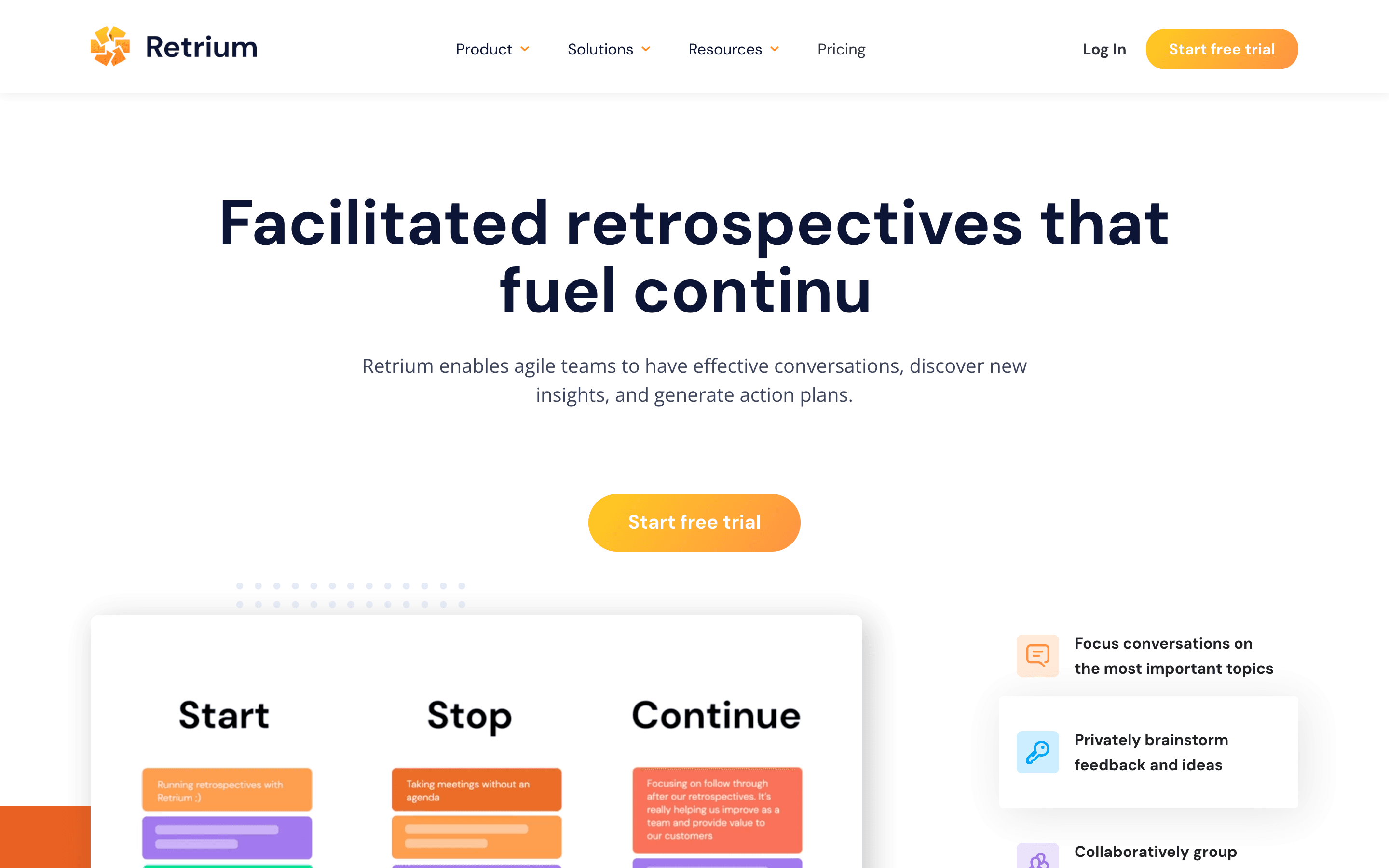
Retrium does one thing and does it well. The guided facilitation is polished. The Think phase blurs notes by default to prevent groupthink. The vote count formula (square root of total groups plus ideas) is a small but smart design choice that prevents vote dilution in larger groups. Team Radar tracks health with spider graphs and customizable spokes. The Slack integration goes deep, too. You can join retros from Slack, get real-time progress updates, and receive weekly Monday action item summaries.
Retrium is the only dedicated retro tool with a full async workflow. Facilitators set a timeframe for the Think phase, team members submit cards on their own schedule, then the group reconvenes for discussion. TeamRetro's brainstorming phase can be async, but grouping, voting, and discussion are synchronous only.
But Retrium has no AI features. Zero. The facilitator reads through every card, drags them into groups by hand, and writes the summary afterward. For a 15-person team generating 60+ cards, that's 15 minutes of tedious work that TeamRetro handles in seconds.
Pricing Comparison
TeamRetro is cheaper at every comparable tier, which is unusual for the tool with more features.

Retrium
Unlimited users per room
- All techniques and Team Radar included
- No free tier — 30-day trial only
- Business $59/mo: SSO, priority support
- No refund policy

TeamRetro
Up to 25 members on Single Team
- Unlimited retros, health checks, and poker
- No free tier — 30-day trial only
- Small Org $60/mo: 3 teams, unlimited members
- SSO/SAML included on every paid plan
Both charge per team rather than per user, which keeps costs predictable. TeamRetro starts $14/month cheaper and includes SSO/SAML on every paid plan. Retrium gates SSO behind the Business tier at $59/month. Run the numbers for three teams: $117/month on Retrium Business vs $60/month on TeamRetro Small Organization.
Neither offers a permanent free tier. Both give you 30 days to evaluate. Retrium's trial limits you to column-based and team radar techniques only, while TeamRetro's trial gives full access.
Ease of Use
These are the two most structured retro tools on the market. Neither dumps you on a blank canvas.
Retrium's five-phase flow (Think, Group, Vote, Discuss, Wrap Up) is cleaner for first-time facilitators. Phase instructions are explicit. The timer has pause, reset, and alert sound controls. You can swap the facilitator mid-session if someone needs to step out. If your Scrum Masters rotate every sprint, the near-zero learning curve matters.
TeamRetro's workflow is similar but busier. More on screen: icebreakers, AI grouping suggestions, sentiment indicators, kudos badges, quick polls. A new facilitator might need a sprint or two to feel comfortable. Once they do, the AI handles the grunt work, and you spend less total effort per retro even though the ramp-up is slightly steeper.
Integrations
TeamRetro connects to 15 tools: Jira (two-way sync since December 2025), GitHub, Slack, Azure DevOps, Linear, Confluence, Trello, Microsoft Teams, Asana, Basecamp, ClickUp, Monday.com, Notion, Shortcut, and GitLab. All export-oriented. No import integrations.
Retrium's list is shorter. Jira Cloud for action item export (one-way, no Server/Data Center support confirmed). A full Slack app with real-time updates and weekly summaries. Action item export to GitHub, Trello, ClickUp, and Asana. No Confluence, no Linear, no Azure DevOps, no Notion.
TeamRetro's Jira two-way sync (shipped December 2025) means action item titles and completion status stay in sync between both tools. Retrium's Jira integration is one-way export only — you create the issue in Jira, but updates don't flow back.
If your team lives in Jira and Slack exclusively, Retrium's Slack app is arguably better than TeamRetro's Slack notifications. Any other toolchain, and TeamRetro wins on breadth.
AI and Automation
This is where the gap is widest.
TeamRetro has AI grouping for affinity mapping, auto-generated meeting summaries, sentiment analysis with heat maps and trend tracking, and AI-powered icebreaker questions. They upgraded the underlying models in July 2025 and added AI-generated custom templates: describe the retro format you want and the tool builds it.
Retrium has nothing here. Grouping is manual (there's a "silent grouping" option where participants collaborate, but it's still drag-and-drop). Summaries are manual. Sentiment tracking doesn't exist. At $39/month in 2026, that's a hard sell against a $25/month competitor that automates half the facilitation work.
Who Should Choose Which?
Choose Retrium if…
- Your distributed team needs truly async retros across time zones
- You want the deepest Slack integration of any retro tool
- Your facilitators rotate every sprint and need zero-learning-curve guided workflows
- Enterprise procurement is already in place and switching costs outweigh savings
- You prefer a focused tool that does retros and nothing else
Choose TeamRetro if…
- You want AI to handle card grouping and summary generation
- Your team needs health checks and planning poker alongside retros
- You use GitHub, Linear, Azure DevOps, or any tool outside the Atlassian/Slack ecosystem
- SSO/SAML on every paid plan matters to your IT department
- You want more features at a lower price point ($25/mo vs $39/mo)
Final Recommendation
TeamRetro is the better pick for most teams in 2026. It matches Retrium's guided facilitation, adds AI that Retrium lacks entirely, bundles health checks and planning poker, connects to 15 tools instead of roughly half that, includes SSO on every plan, and costs $14/month less. The product has shipped monthly updates through 2025 and into 2026.
Retrium isn't a bad tool. The async retro workflow matters for teams spread across time zones, and the Slack integration is the best in this category. But no AI and a slower development pace put it behind. If you're evaluating both for the first time, start with TeamRetro's 30-day trial. You'll probably find it covers everything Retrium does, for less money.
Comparing either of these to broader agile platforms? See EasyRetro vs TeamRetro or EasyRetro vs Retrium.