

Overview
Echometer came out of the University of Munster's psychology department in 2019, and you can tell. This is not a retro tool that started with sticky notes and added features. It started with research on what actually makes teams improve, then built a product around that.
The core idea is simple but unusual: embed validated health check surveys directly into your retrospectives. Instead of opening a retro with "what went well, what didn't," Echometer has your team rate statements like "I feel comfortable raising problems in this team" on a scale. Do that consistently across sprints and you get trend data. Actual numbers showing whether your team health is improving or sliding.
That is a real difference from what Neatro or Retrium offer. Those tools treat health checks as a separate activity you schedule alongside retros. Echometer puts them inside the retro itself.
Pros
- Health checks baked into the retro flow, not bolted on as an afterthought
- 200+ research-based health check questions give facilitators a real starting point for deeper conversations
- Flat team pricing with unlimited members keeps costs predictable
- GDPR-first design with German hosting, which matters if your compliance team has opinions about data residency
Cons
- Jira is the only real integration (no Slack, no GitHub, no Azure DevOps, no Linear)
- No planning poker, standups, or multi-ceremony support
- Free tier drops to 1 retro per month after the 3-week trial
- 1:1 meeting tool is priced and sold separately, which adds up fast
Key Features
Integrated Health Checks
Echometer's whole identity is built around this. Over 200 health check questions drawn from organizational psychology research, covering things like team spirit, psychological safety, appreciation, meeting culture, and knowledge sharing. Each team member answers anonymously on a scale, and the results go straight into the retro discussion.
Run the same checks across multiple sprints and Echometer plots the trends. You can see at a glance whether that action item from three sprints ago about "improving communication" actually moved the needle or just made everyone feel productive for an afternoon.
Health checks work best when you pick 3-5 dimensions and stick with them for a quarter. Rotating all 200 questions defeats the purpose of tracking trends.
The cross-team view is worth mentioning. If you are an agile coach managing several squads, Echometer aggregates health data across teams so you can spot patterns. Maybe three teams all score low on "recovery and breaks." That is an organizational problem, not a team one.
Guided Retro Facilitation
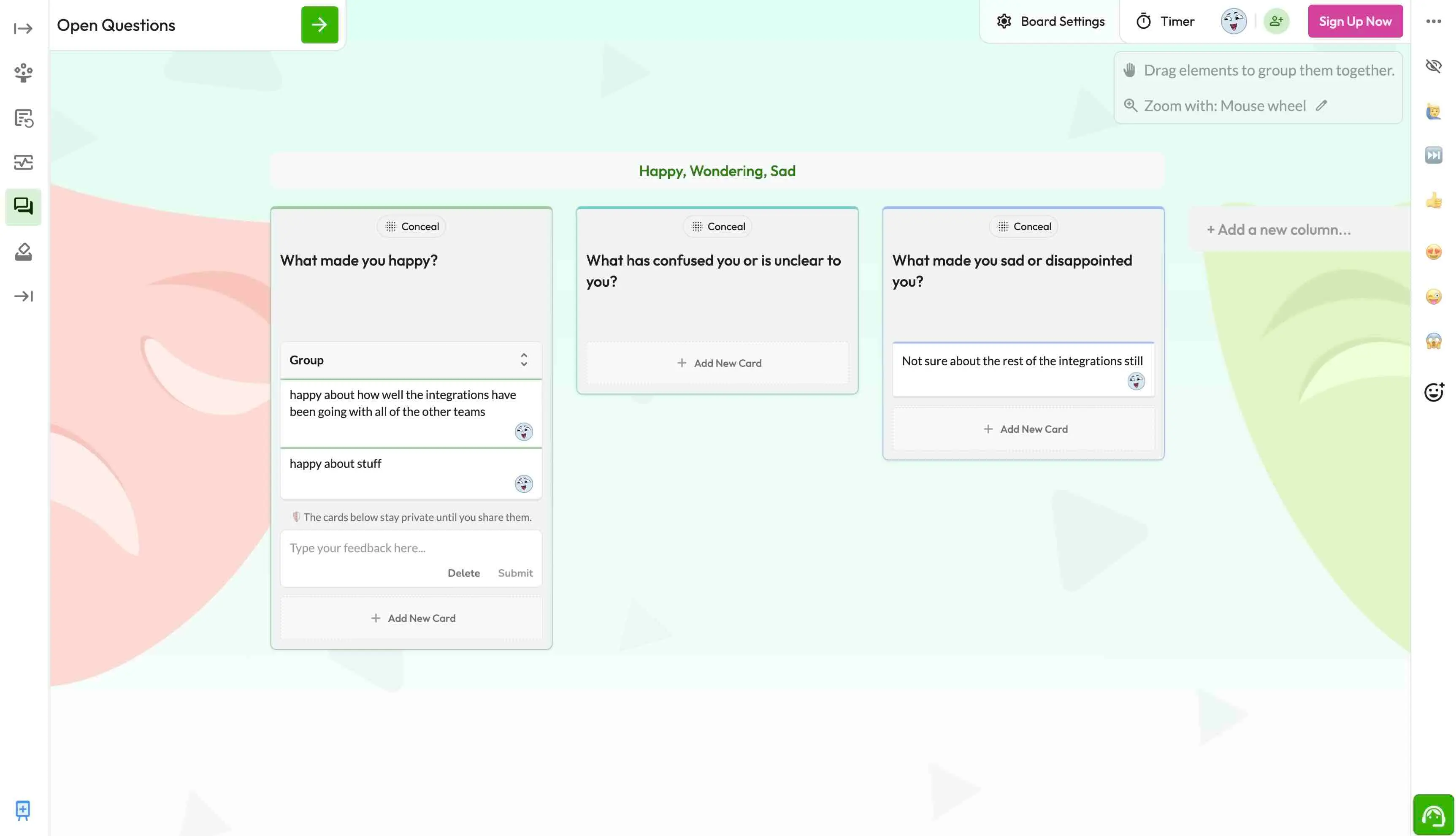
Every Echometer retro follows a structured agenda: check-in, health check survey, open discussion on the retro board, voting, action planning, and a ROTI check-out. The facilitator clicks through phases, cards stay concealed during brainstorming to prevent anchoring, and a timer keeps each phase on track.
54+ retro formats are available: Sailboat, Keep-Stop-Start, Starfish, DAKI, KALM, and plenty of creative variations. You can build custom templates on the Pro plan. The format variety is solid, though not as deep as Kollabe's 1,000+ options or Metro Retro's hand-illustrated boards.
Anonymous Feedback and Blind Voting
Anonymity is on by default in Echometer. Health check responses are anonymous. Retro board cards are anonymous. Voting is blind, meaning participants cannot see how others voted until the facilitator closes the round.
Two voting modes exist. Live Voting is the standard: the facilitator sets votes per person, everyone votes simultaneously, cards auto-sort by count when voting closes. Facilitated Voting lets the moderator allocate votes to specific topics, which is handy when the discussion needs steering.
AI Recommendations
Echometer's AI suggests action items based on your team's discussion topics. It is not auto-grouping cards like Miro or Kollabe does. Card grouping is still manual drag-and-drop. But when your team is stuck on "what should we actually do about this," the AI can propose concrete next steps.
The 1:1 tool takes AI further with meeting transcription and coaching feedback for managers. Tells you things like "you asked mostly closed questions in this session" or "consider giving more specific recognition." Useful if you are training new engineering managers.
1:1 Meeting Tool
This is a separate product, priced separately, but worth covering because it is unique in the retro tool space. No other tool on this list combines retrospectives with 1:1 meeting software.
The 1:1 tool includes live-synced notes, templates for different conversation types, check-in KPIs that track employee satisfaction over time, a hashtag system for tagging recurring themes, private manager notes, and calendar sync with Google and Microsoft. AI transcription and coaching feedback come standard.
The 1:1 tool costs €29/month per manager on top of the retro subscription. Only managers need licenses, but if you have 5 engineering managers, that is an extra €145/month.
Async Pre-Retro Surveys
Before the live meeting, Echometer can send pulse check surveys to collect anonymous feedback asynchronously. Team members respond on their own schedule, and the results are ready when the retro starts. Good for distributed teams who want richer input than what a 45-minute meeting produces.
Integrated Whiteboard
An optional whiteboard mode lets teams brainstorm freely beyond the structured card format. It is not as polished as Miro's infinite canvas, but it adds flexibility for teams that find column-based boards too rigid for certain discussions.
Pricing
Echometer uses team-based pricing. Everyone on the team is included regardless of headcount.
- Starter (Free): 1 team, unlimited members. All retro features including health checks. After a 3-week trial period, limited to 1 retro per month. 6-month archive. Guest access without login.
- Pro (€29/team/month annual, €35 monthly): Unlimited retros, full customization of templates and health checks, unlimited archive, multiple teams.
- Business (€49/team/month annual, €60 monthly): Adds SAML SSO, email domain security filters, custom contracts, invoice billing, priority support.
Volume discounts kick in at 10+ teams on annual plans.
The free tier is usable but tight. One retro per month after the trial means you cannot run biweekly retros without paying. Compare that to Neatro, which gives you unlimited retros on the free plan, or Parabol, which is free for up to 2 teams with no retro limits.
The 1:1 meeting tool is priced separately at €29/manager/month (annual). Free for up to 2 direct reports. Budget for both products if you want the full Echometer experience.
At €29/team/month, the retro tool alone sits in the same range as Neatro and Kollabe. But Kollabe includes planning poker and standups at that price. You are paying a similar amount for a narrower feature set, which only makes sense if health check integration is the thing you actually need.
Ease of Use
Getting started is quick. The facilitator creates an account, picks a retro format, and shares a link. Participants join as guests without creating accounts.
The guided agenda flow is where Echometer shines for less experienced facilitators. You do not need to know the theory behind a good retro. Click through the phases, the tool handles the structure, and the health check questions give the team something concrete to discuss instead of staring at a blank board. First-time scrum masters will appreciate having guardrails.
The trade-off is flexibility. If you want to freestyle a retro or deviate from the structured flow, Echometer's opinionated design can feel constraining. Tools like Miro or Metro Retro give you a blank canvas where anything goes. Echometer gives you a workflow where the tool has opinions about how your retro should run.
Mobile works. Participants can join from their phones for on-site or hybrid retros, and the responsive design holds up. No native apps though.
Who Is It Best For?
Echometer fits well for:
- Agile coaches tracking team development across multiple squads with quantitative health data
- Scrum masters who want structured facilitation without building the structure themselves
- Organizations with strict GDPR requirements that need German-hosted data
- Teams transitioning from informal retros who want a guided, research-based approach
Look elsewhere if you need:
- Multi-ceremony support. No planning poker or standups here. Try Kollabe or Parabol
- Deep integrations. Jira is it, and it is export-only for action items
- SOC 2 compliance. Echometer does not have it, TeamRetro does
- A free tool for regular use. The 1 retro/month cap on the free plan is restrictive
The Verdict
Nothing else on this list bakes health check surveys directly into the retro flow and tracks the results over time. If you have been running retros for years and still cannot point to measurable improvement in team dynamics, that is the problem Echometer was built to solve.
The narrow focus is a deliberate choice, not a gap. But it does mean you will need other tools alongside it. No poker, no standups, basically just Jira for integrations. The 1:1 meeting product is interesting but doubles your cost.
For agile coaches who care about measuring team health, not just facilitating meetings, Echometer is worth the trial. For everyone else, a broader tool like Kollabe or Parabol will cover more ground.