

Quick Verdict
This is the $29 platform against the $0 board, and the interesting part is how much the $0 board gets right.
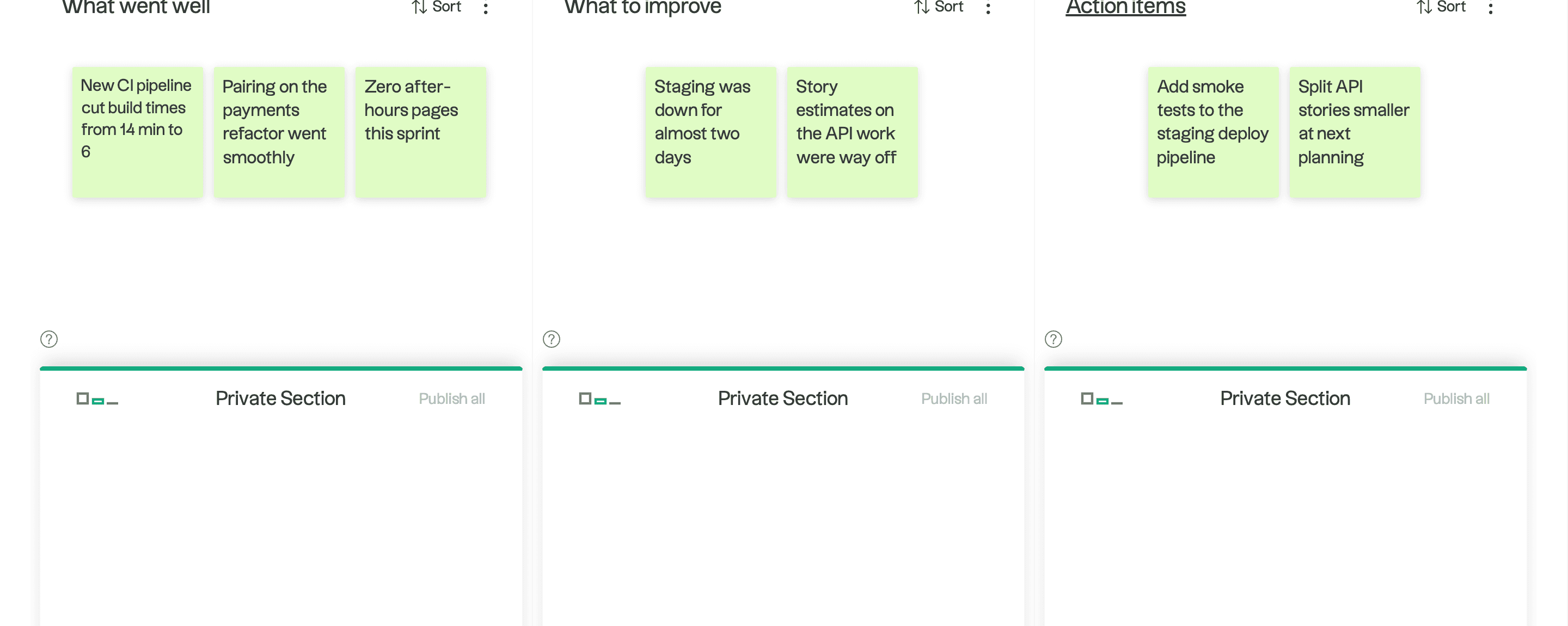
RetroTool, a side project of the agency u2i, is the best genuinely free retro tool we have reviewed. Private sections let people draft cards without anchoring the room, secret voting hides dots until reveal with limits per retro, column, or card, and action points take owners and due dates. No accounts required for anyone, ever.
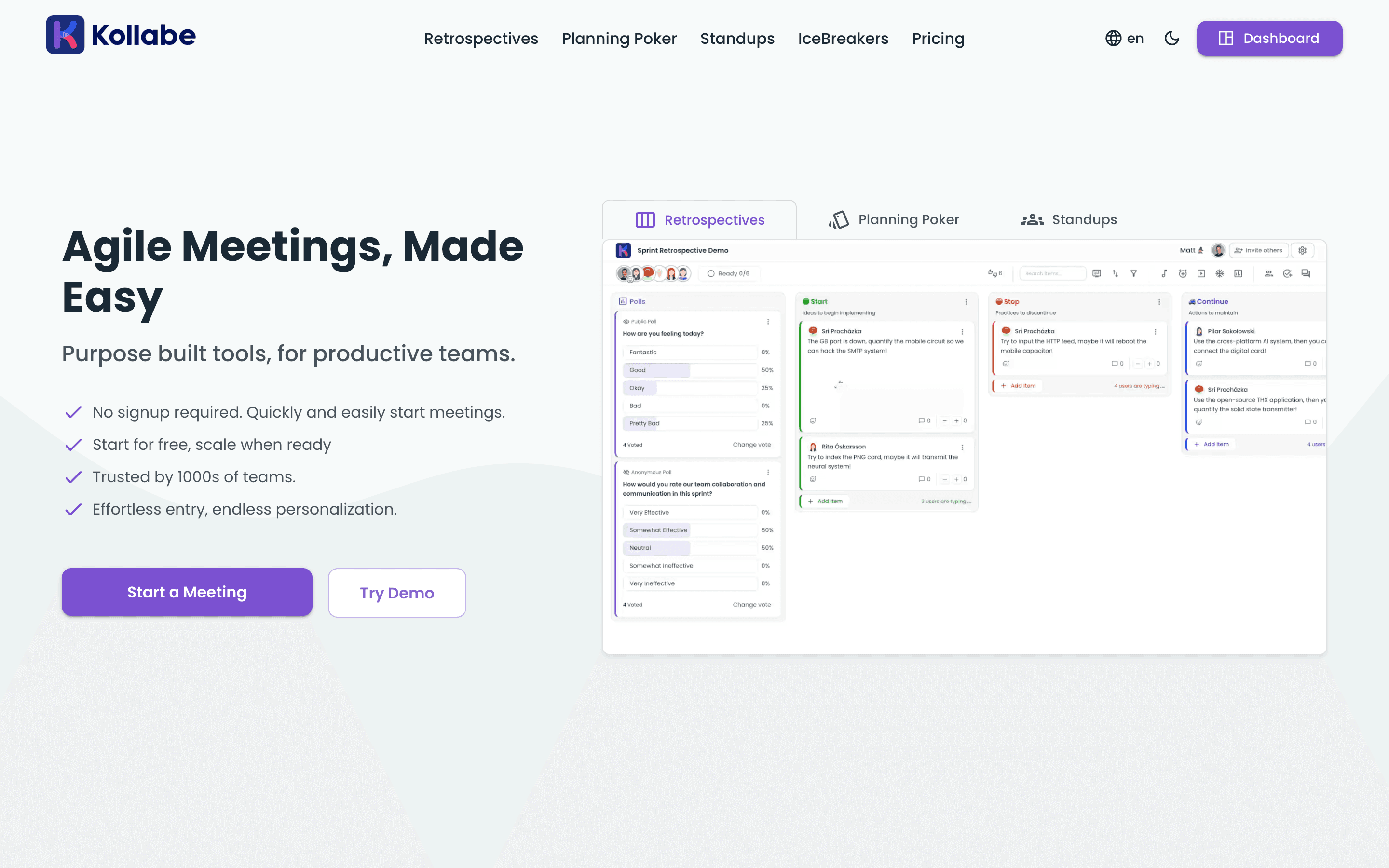
Kollabe is what you get when the retro board is a business instead of a side project: AI grouping and steerable summaries, 1,000+ templates, guided phases, Jira/GitHub/Azure DevOps/Linear integrations, plus planning poker and async standups in the same $29/month.
Teams with budget should buy Kollabe and not think twice. Teams without budget should use RetroTool over IdeaBoardz or RetroBoard and understand exactly what they are standing on.
Feature Comparison
Both tools understand facilitation, which is what separates this comparison from Kollabe against the other free boards.
RetroTool's core mechanics are legitimately good. The private-then-publish flow (draft in your own section, drag to public when ready) is the same anti-anchoring idea Miro sells as private mode. Secret voting with a per-card vote cap solves problems most paid tools ignore. The timer, read-only lock, and action points with owners round out a kit a real scrum master would design.
From there, everything else belongs to Kollabe. AI grouping by semantic similarity against RetroTool's drag-things-near-each-other. A thousand-plus templates against three. Threaded comments, reactions, kudos, polls, and themes against cards that can hold a GIF. Sentiment trends and engagement analytics against nothing. And an actual company shipping updates weekly against a product whose blog went quiet in March 2022.
RetroTool shows no visible development since roughly 2020, and its free boards are open to anyone holding the URL, with private invite-only boards gated to paid plans. Neither fact makes it unusable, but both belong in the decision if you are picking a tool your team will depend on every sprint.
Ceremony breadth is the usual Kollabe argument: planning poker with ticket import and estimate write-back, async standups with AI digests. RetroTool does retros and nothing else.
Pricing Comparison
Flat per team on both sides, at very different altitudes.

Kollabe
Flat per team — retros, poker, and standups included
- Unlimited participants and history
- All AI features included
- Planning poker and async standups included
- Free tier available (10 participants)

RetroTool
Paid: $10/team/month for private boards and archive
- Unlimited participants, cards, and boards free
- No accounts required for anyone
- Timer, secret voting, action points included free
- Free boards stored 12 months
RetroTool's free tier embarrasses most paid free tiers: unlimited everything, real facilitation tools, no signup. Its $10 Individual plan (private boards, infinite archive, 3 teams) is a third of Kollabe's price, and the $20 Company tier adds zero-knowledge encryption, which nothing else in this directory offers at any price.
What $29 buys instead of $0-10: the AI, the integrations, the ceremonies, the analytics, and a vendor with a roadmap. If your team runs poker separately today, Kollabe's bundle math wins on its own. If your team runs retros only and manually files action items anyway, RetroTool's price is hard to argue against.
Mind the free-tier expiry: RetroTool deletes free boards after 12 months. Export the Markdown.
Ease of Use
Both are easy; they are easy differently. RetroTool's three-clicks-to-a-board claim is accurate, and the interface is plain enough that nobody asks questions. The private-section flow needs one sentence of explanation.
Kollabe's onboarding is nearly as light (participants join by link, no accounts) and the meeting itself does more of the work: phases advance, AI clusters the cards, the summary writes itself. RetroTool's facilitator does the sorting by hand and reads duplicates aloud, because there is no grouping or merging at all.
Both are responsive in a mobile browser; neither has native apps.
Integrations
RetroTool has none. Zero. The only way data leaves is a Markdown file. Its own FAQ confirms no integrations are offered.
Kollabe connects two-way with Jira, GitHub, Azure DevOps, and Linear, exports retros to Confluence, and opened a public API in February 2026. Its known gap, no Slack or Teams, is at least a gap RetroTool shares.
For a team whose action items must land in a tracker, this section alone settles the comparison.
AI and Automation
RetroTool predates the AI wave and sat it out entirely: no grouping, no summaries, no sentiment, no automation beyond vote sorting.
Kollabe's AI is central: semantic card grouping, summaries with custom instructions, sentiment and engagement trends, an AI template generator, and standup digests. Whether that is worth $29 a month is a fair question; that it exists on one side of this table and not the other is not.
Who Should Choose Which?
Choose Kollabe if…
- Action items must sync to Jira, GitHub, Azure DevOps, or Linear
- AI grouping and summaries save real facilitation time
- You also run planning poker and standups
- You want a vendor that ships updates weekly
- Sentiment and engagement trends matter across sprints
Choose RetroTool if…
- Budget is zero and the retro still deserves real mechanics
- Private drafting and secret voting matter to your facilitation
- No-account access for every participant is a requirement
- EU hosting and GDPR posture are a plus
- You already track action items somewhere else anyway
Final Recommendation
Kollabe is the recommendation for any team that can spend money on this problem. The gap is not one killer feature but the accumulation: AI, integrations, ceremonies, analytics, and active development against a tool that offers none of the four and last visibly shipped before some of your teammates joined the industry.
RetroTool earns real respect within its lane. It is the best free retro board in our free tools roundup, the only one with anti-anchoring mechanics and assignable action points, and its $10 tier is the cheapest private-board option in the directory. For a small team bootstrapping its retro habit, it is a genuinely good place to start.
Start free on RetroTool if you must, and move to a platform when the manual follow-through starts costing more than $29 a month of anyone's time. That day comes sooner than most teams expect.