

Overview
RetroTool (not to be confused with this site) is a side project of u2i, a software agency based in New York with its engineering in Krakow, Poland. The homepage counter claims over 985,000 retrospectives created, and the free tier explains why: click "Create free, anonymous retro," and you have a working board. No account, no email, no trial clock. Nobody who joins needs one either.
What separates it from the other free boards we cover is that someone who actually facilitated retros clearly designed it. It has the mechanics that matter in the room: private drafting, secret voting, a timer, vote limits, action points with owners.
It also, visibly, stopped evolving around 2020. The blog last posted in March 2022, the terms haven't changed since August 2020, and there is no changelog. The product works fine. It just isn't going anywhere.
Pros
- Private-then-publish sections prevent anchoring, a feature even Miro charges for
- Secret voting with per-column and per-card limits is real facilitation control
- Action points have owners and due dates, rare in a free tool
- Truly free: unlimited participants, cards, and boards, no account required
Cons
- Zero integrations: no Jira, no Slack, nothing but Markdown export
- Dormant: no visible development since roughly 2020
- Only three built-in templates plus blank boards
- Free boards are open to anyone with the URL; private boards cost $10/month
Key Features
Private Sections
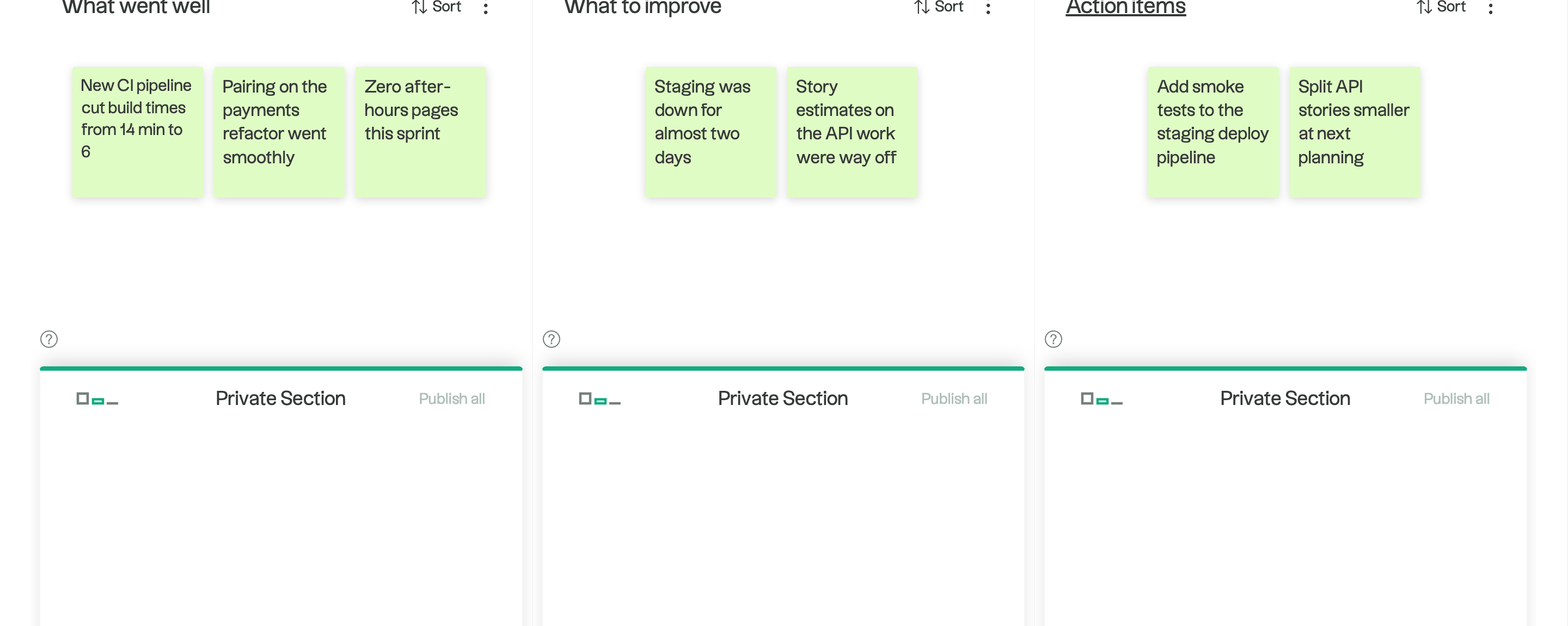
Every column has a Private Section, a personal workspace only that participant can see. You draft cards there during brainstorming, then drag them up to the public section when ready.
This is RetroTool's best idea. Hiding cards during writing prevents anchoring, where early cards steer everyone else's thinking. Miro offers this as "private mode," Echometer conceals cards by default, and most free tools don't attempt it at all. Getting it in a no-account free board is remarkable.
Secret Voting With Real Controls
Dot voting hides everyone's votes until the facilitator reveals them, and the vote limits are unusually granular: cap votes for the whole retro, per column, or even per single card. That last one quietly solves the "everyone dumps three votes on the funny card" problem.
Action Points
Cards can become action points with an assigned owner and a due date, and an action-point view collects them across a team's past retros. That is more follow-through than IdeaBoardz (nothing) or RetroBoard (nothing) offer, and it is the main reason RetroTool outranks both.
The ceiling is low, though. Action points live only inside RetroTool. With no Jira export, no Slack ping, and only Markdown export, someone still has to move commitments into the real tracker by hand.
Free boards are accessible to anyone who has the URL. Invite-only private retros are a paid feature ($10/team/month), so treat free boards like IdeaBoardz boards: fine for routine team retros, wrong for anything sensitive.
Boards, Templates, and Media
Three built-in formats ship with the tool: Mad/Sad/Glad, Start/Stop/Continue, and Liked/Learned/Lacked, plus a blank board where you name your own columns, set colors, and add header images. Cards take images and GIFs, which adds some life to an otherwise plain interface.
Compared to EasyRetro's 200+ templates or Kollabe's 1,000+, three formats is thin. In practice most teams rotate through exactly these three anyway.
Pricing
- Anonymous (Free): Unlimited participants, cards, columns, and action points. Timer, voting, private sections, Markdown export. Boards stored up to 12 months.
- Individual ($10/team/month): Up to 3 teams, infinite archive, private invite-only retros, configurable data retention, advanced facilitation tools. 90-day trial.
- Company ($20/team/month): Unlimited teams, assign teams to scrum masters, zero-knowledge encryption with custom passwords.
Per-team pricing at $10 flat undercuts nearly everything: Kollabe is $29, EasyRetro $38, Neatro $29. Of course, those tools ship AI, integrations, and far more features. What you are buying here is privacy controls and an archive on top of an already-usable free tool.
The 12-month board expiry on free is worth knowing about. Your January retro disappears next January unless you pay or export.
Ease of Use
Three clicks from homepage to working retro is the marketing claim, and it holds up. The interface is clean, if plain, and participants understand it instantly. The Private Section drag-to-publish flow needs one sentence of explanation and then runs itself.
Facilitators get a decent kit: timer, secret voting toggles, vote caps, read-only lock at the end. There is no phased wizard, so you drive the agenda, and there is no grouping or merging, so duplicate cards get discussed twice unless you drag them near each other and squint.
Some reviewers note the timer is easy to miss on screen. Minor, but real.
Who Is It Best For?
RetroTool fits well for:
- Small teams with no budget who still want real facilitation mechanics, not just a shared page of stickies
- Facilitators who care about anchoring and want private drafting without paying Miro prices
- EU teams that prefer EU-hosted, GDPR-respecting tools
- Anyone graduating from IdeaBoardz who isn't ready to pay yet
Look elsewhere if you need:
- Integrations of any kind. There are none; Kollabe or EasyRetro cover Jira
- AI grouping or summaries. Nothing here; see Stormboard or Kollabe
- A vendor with a roadmap. This is an unmaintained agency side project
- Async retros with scheduling and reminders. Boards are built for live sessions
The Verdict
Within the free tier of this directory, RetroTool wins. It has the timer IdeaBoardz lacks, the voting controls RetroBoard lacks, the anti-anchoring flow almost everyone lacks, and action points with owners that no free competitor attempts. For a small team running honest live retros on zero budget, this is the recommendation.
The asterisks matter, though. No integrations means manual follow-through forever. URL-open free boards limit what you can safely discuss. And betting your team's ceremony on a dormant side project means accepting that a bug or a shutdown will be permanent.
Use it, enjoy it, export your action items, and keep our free retro tools guide bookmarked in case the lights ever go out.