

Quick Verdict
These two overlap more than you would guess. Both do anonymous input, AI grouping, AI summaries, sentiment analysis, voting, timers, and assignable action items. The difference is what wraps around that core.
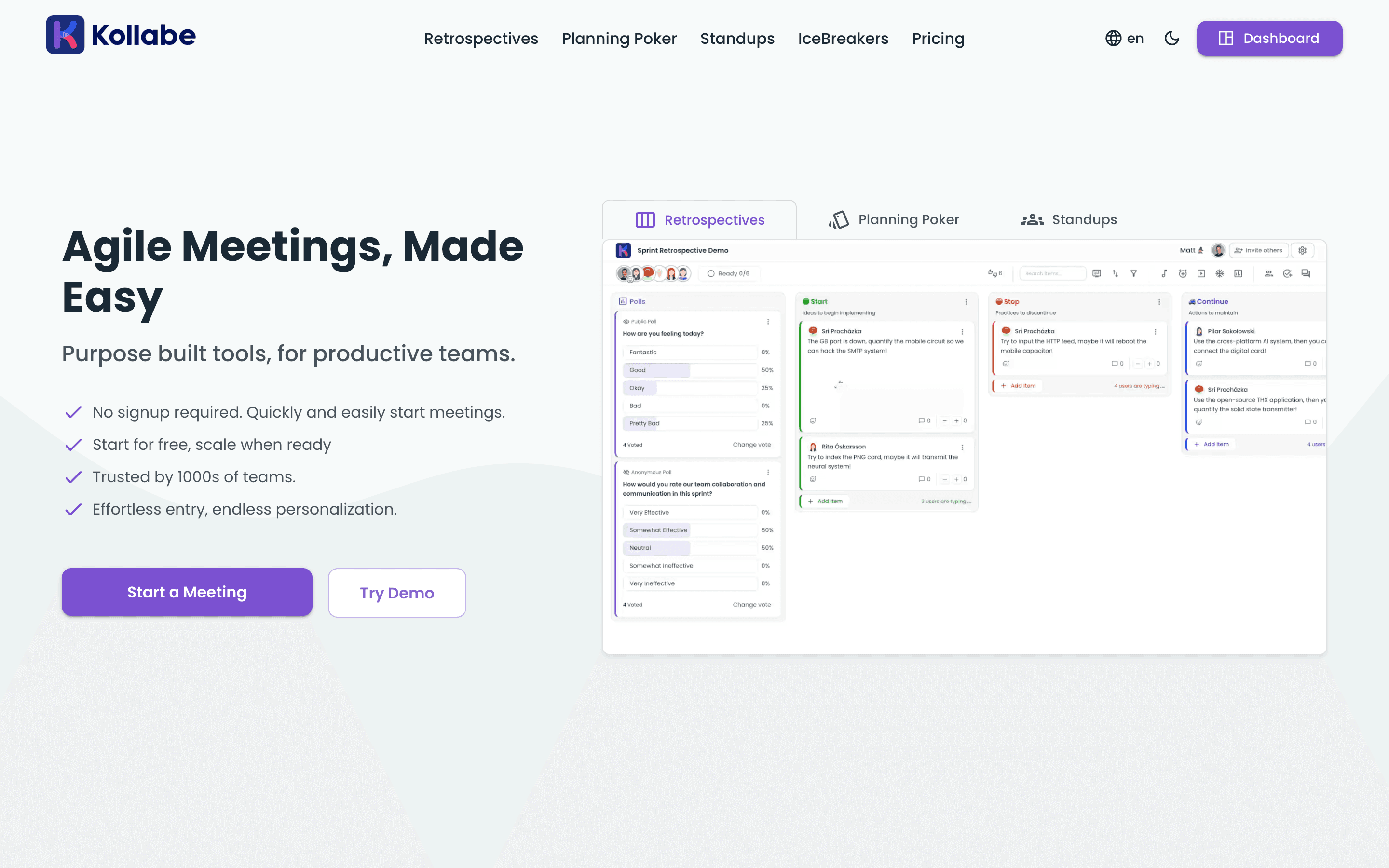
Kollabe wraps it in a retro workflow: guided phases, 1,000+ templates, themed boards, polls, kudos, and then planning poker and async standups in the same $29/month subscription. It is a ceremonies platform.
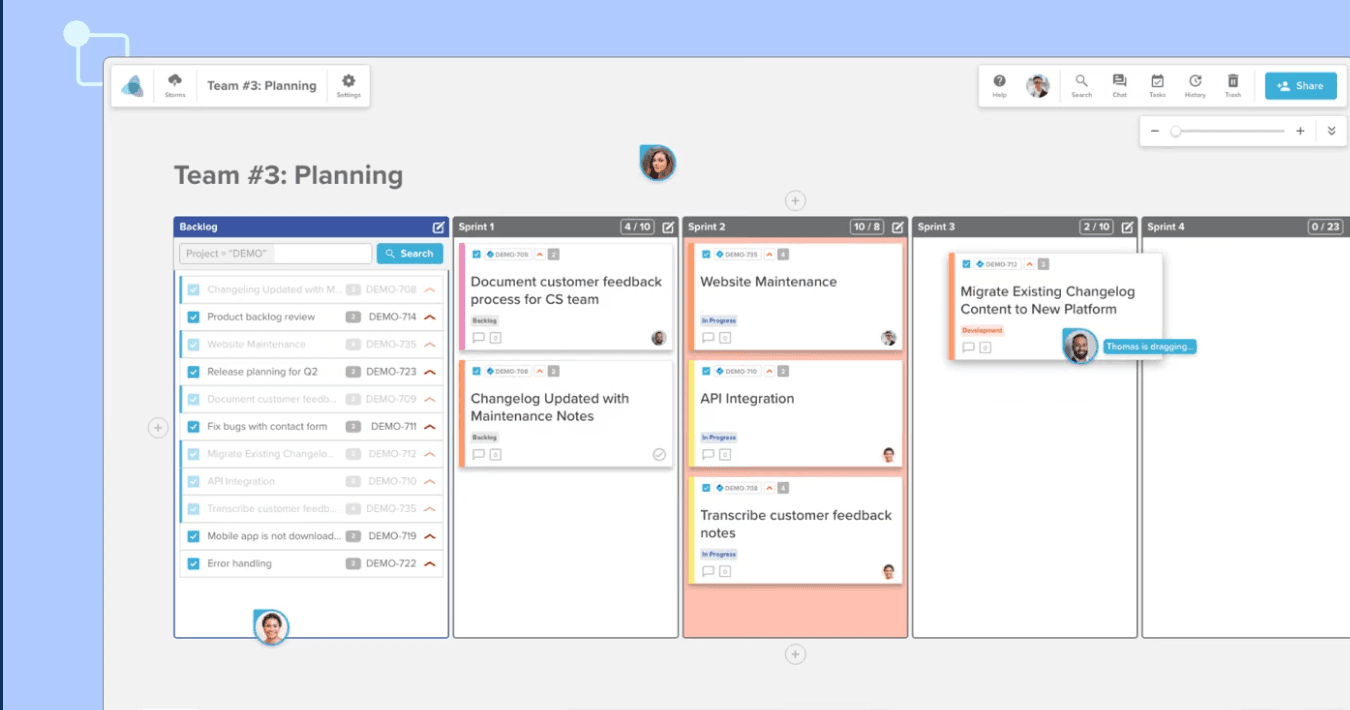
Stormboard wraps it in an enterprise whiteboard: a freeform canvas that also runs sprint and PI planning boards, exports to Word, PowerPoint, Excel, and Google formats, syncs two-way with Jira and Azure DevOps, and carries SOC 2 Type II with single-tenant hosting in eleven-plus regions. It is an output machine.
Most agile teams should pick Kollabe. Enterprises with compliance gates and stakeholders who expect a document after every session should look hard at Stormboard.
Feature Comparison
Start with the shared ground, because it is unusually broad. Both hide authorship (Stormboard by default, Kollabe per session), both group stickies with AI, both summarize, both read sentiment, both assign action items with owners and due dates. On the raw retro checklist, Stormboard is the closest any whiteboard gets to a purpose-built tool.
The gaps show in the meeting itself. Kollabe gives facilitators phases to walk through, per-phase timers, inline polls, themed boards, GIFs, and kudos. Stormboard gives you a canvas, a timer only admins can run, and no guided flow at all. A new scrum master gets rails in one and a blank page in the other.
Then there is ceremony breadth. Kollabe runs planning poker with ticket import from Jira, GitHub, Azure DevOps, and Linear, and async standups with AI digests. Stormboard has a story-point sizing template and no standups. If your team needs those ceremonies, Kollabe replaces two extra subscriptions.
Stormboard's killer feature is the one Kollabe does not attempt: reports. A finished Storm exports as a formatted Word document, PowerPoint deck, Excel workbook, Google Doc, or raw CSV/JSON/XML. Kollabe exports PDF, Markdown, CSV, JSON, and Confluence pages, which is solid, but Stormboard's stakeholder-ready documents are in a different league.
Pricing Comparison
Different models: flat per team versus per user.

Kollabe
Flat per team — retros, poker, and standups included
- Unlimited participants and history
- All AI features included
- Planning poker and async standups included
- Free tier available (10 participants)

Stormboard
Business plan; ~$8.33 billed annually
- Unlimited Storm members
- Full reporting and exports
- 30-day StormAI trial included
- Free plan capped at 5 members per Storm
The math turns on headcount. A five-person team pays $29 for Kollabe or roughly $42-50 for Stormboard. At ten people it is $29 versus $83-100. Kollabe's flat rate wins at every realistic team size, and its free tier (10 participants) is usable where Stormboard's 5-member Storm cap is not.
Stormboard's counterargument is what the money buys: SOC 2 now, data residency, native desktop and mobile apps, and those exports. Enterprises comparing it against Miro Business at $16/user will find Stormboard cheap. Teams comparing it against flat-rate retro tools will not.
One more asterisk: StormAI is a 30-day trial on Business and admin-activated on Enterprise, so confirm its cost at renewal before you count on it. Kollabe includes all AI in the $29.
Ease of Use
Kollabe is the friendlier product. The interface is modern, participants join by link without accounts, and the guided phases mean the tool carries the meeting structure. Themes and GIFs read as fun rather than clutter.
Stormboard is denser. The object-based canvas (stickies snap into sections) is genuinely useful for keeping a retro organized, but the UI shows its 2009 roots and reviewers regularly call it busy. Budget one session of orientation for a new team.
Hardware is Stormboard's quiet advantage: native Windows, Surface Hub with handwriting recognition, and iOS/Android apps. A hybrid retro with half the team around an 84-inch touchscreen is a real Stormboard scenario and an impossible Kollabe one, since Kollabe is responsive web only.
Integrations
Both integrate two-way with Jira and Azure DevOps, and that is where the overlap ends.
Kollabe adds GitHub and Linear with estimate write-back for poker, plus Confluence export. Stormboard adds Microsoft Teams (embed Storms in a tab), Slack notifications, Rally, ServiceNow, Webex, Zoom, Office 365, Google Workspace, Zapier for everything else, and a public API. Kollabe shipped its own public API in February 2026.
The shape matters more than the count: Kollabe's integrations serve dev-team ceremonies (tickets in, estimates and action items out), while Stormboard's serve enterprise plumbing (meetings, documents, workflow tools). Kollabe still has no Slack or Teams presence at all, which Stormboard partially covers.
AI and Automation
Near parity, surprisingly. Both group by theme, both summarize, both read sentiment. Kollabe's AI is steerable (custom instructions on summaries) and extends across standup digests and an AI template generator. StormAI generates templates from prompts too, and adds AI idea generation for brainstorms.
Two real differences. Kollabe's sentiment tracks trends across sessions, while Stormboard's sorts the current board. And access: Kollabe's AI is included in the flat rate for everyone, while StormAI is trial-gated on Business, excluded for guests, and possibly chargeable at Enterprise renewal.
Who Should Choose Which?
Choose Kollabe if…
- You want guided retro facilitation, not a blank canvas
- You run poker and standups and want one $29 subscription
- Flat pricing regardless of team size
- AI included for everyone with no trial gates
- GitHub and Linear are in your stack
Choose Stormboard if…
- Retro output must become Word, PowerPoint, or Excel reports
- You need SOC 2 Type II and data residency options today
- Hybrid sessions on Surface Hub or big touchscreens
- Sprint and PI planning boards on the same canvas
- Microsoft Teams embedding matters to your org
Final Recommendation
For the core job of running better retrospectives, Kollabe is the stronger tool. The guided flow, the breadth of the toolkit, and the poker and standup coverage at a flat $29 make it the better buy for almost any team actually choosing a retro platform.
Stormboard wins a specific and real customer: the enterprise team whose security review demands SOC 2 and residency options, whose stakeholders expect a document, and whose retros share a canvas with sprint planning and PI planning. More than half the Fortune 50 reportedly use it, and that is not an accident.
Pick by what happens after the retro. If the output is team follow-through, Kollabe. If the output is a report to someone above you, Stormboard. Our best retrospective tools guide has the full field if neither fits.